 PCOS Weight Loss
How to Identify Processed Food in the Grocery Store
A practical guide to spotting processed and ultra-processed food on grocery shelves using the ingredient list, added sugar line and the meal score's quality part.
Published
Quick answer
To identify processed food in the grocery store, read the ingredient list first: a long list, syrups, oils or unfamiliar names usually point to processed or ultra-processed. Then check the added sugar line and how many ingredients a food has to see where it lands.
Key takeaways
- Short ingredient lists of recognizable foods usually score higher on the quality part of the meal score.
- The score counts minimally processed as 1.0, processed as 0.6 and ultra-processed as 0.15, by calories.
- Added sugar can hide under names like cane juice, dextrose or concentrate even without the word sugar.
- Front-of-pack words don't change the ingredient list — the back of the package has the real answer.
- A meal photo estimates quality from the food itself; the app has no barcode scanner or label reader.
To identify processed food in the grocery store, turn the package over and read the ingredient list before anything on the front label. A short list of foods you'd recognize in your own kitchen usually points to minimally processed; a long list with syrups, oils, starches and names you can't picture as food usually points to ultra-processed.
What's the fastest way to spot processed food on the shelf?
Ingredients are listed in order by weight, so the first few names carry the most weight in the product. That single habit — reading the back before the front — catches most of what the front label is designed to distract from.
- Turn the package over and find the ingredient list before reading any front claim.
- Count the ingredients — a short list of foods you could buy on their own points to minimally processed.
- Look partway down the list for syrups, oils, starches and words ending in "-ose."
- Scan for added-sugar names like cane juice, dextrose or concentrate, even if the word "sugar" never appears.
- Compare two similar products side by side and pick based on what matters to you that day.
A plain can of chickpeas might list chickpeas, water and salt — three names, all recognizable. A packaged chickpea snack might list chickpeas, rice flour, sunflower oil, maltodextrin, natural flavor, salt and three preservatives — eight names, several of them unfamiliar. Neither is labeled "good" or "bad" on a package; the list just tells you where each one sits, and over a week of shopping trips that one habit of flipping the package over gets faster the more often you do it.
How does the meal score treat processed and minimally processed food?
The meal score's quality part looks at how processed the food is, by calories, and it's one of four parts that make up the 0–10 score alongside protein, fiber and added sugar.
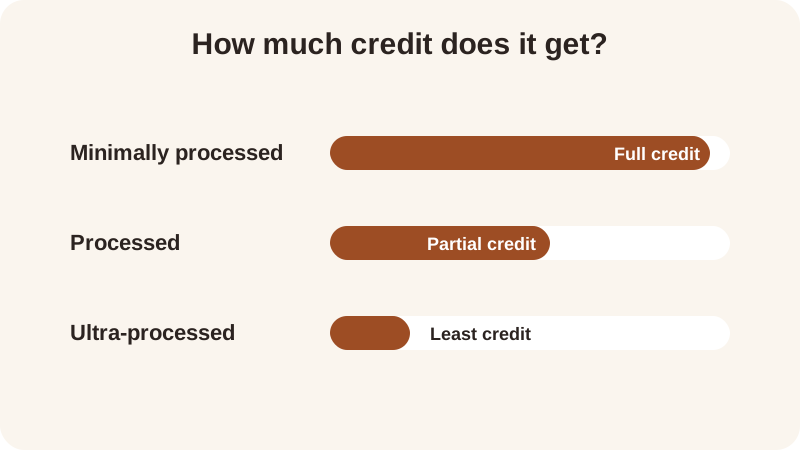
Minimally processed food counts as 1.0, processed counts as 0.6, and ultra-processed counts as 0.15, by calories. Quality is 20% of the overall score, with protein and fiber each at 30% and added sugar at 20%. All four parts are combined unrounded, and only the final score gets rounded for display — so a meal can still land in a reasonable range even if one part is lower, as long as the others carry their share. The how the score works page walks through the full math, and the references it uses — 7 g protein and 2 g fiber per 100 kcal, a flat 12 g added sugar — are general nutrition references, not clinical targets, so they describe where a meal sits rather than telling you what to buy.
Does finding processed food mean you shouldn't buy it?
No — identifying where a food sits on the processing scale just gives you a number for one part of a meal, not an instruction. A packaged cereal, a jarred sauce or a frozen vegetable mix can all still fit into a meal with a meal score; the ingredient list simply tells you what that one part is likely to look like before you even open the app, and you're still the one deciding what goes in the cart.
Here's a worked comparison: a cup of cooked plain rolled oats has about 6 g protein, 4 g fiber and 150 kcal, with an ingredient list of one item. A packet of flavored instant oatmeal with about 4 g protein, 2 g fiber and 160 kcal might list oats, sugar, maltodextrin, salt, natural flavor and two preservatives — six items, with added sugar showing up by name twice. Per 100 kcal, the plain oats work out to about 4 g protein and 2.7 g fiber; the flavored packet comes in lower on both, plus a lower quality score from the longer ingredient list. Stacked side by side on a receipt, the two can look almost identical in price and size, which is exactly why the ingredient list on the back matters more than anything printed on the front.
| Food, typical portion | Ingredient count (about) | Added sugar (about) |
|---|---|---|
| Plain rolled oats, cooked | 1 | 0 g |
| Flavored instant oatmeal packet | 6–8 | 8–12 g |
| Plain Greek yogurt | 2–3 | 0 g |
| Flavored fruit yogurt | 8–12 | 14–20 g |
Neither column is a verdict — it's just what the two versions tend to look like side by side. You can build your own version with chia and berries stirred into the plain oats using the overnight oats with chia recipe, which already has its ingredients and score worked out, or compare it against a packaged option you already have in the pantry to see where each one lands.
A meal photo in the food scanner estimates the quality part from the food it identifies, not from reading a label — the app has no barcode scanner and no nutrition-label reader, so the ingredient-list check above is still something you do with your own eyes in the aisle. If you want the full breakdown of what "ultra-processed" means for the score, the ultra-processed food guide covers it in more depth, and the added-sugar names worth watching for are listed in the spot added sugar on a label guide. You can also type any grocery item's numbers into the meal score calculator to see how it lands before you check out, whether you're comparing two cereals, two yogurts or two versions of the same snack.
Frequently asked questions
What counts as processed food in a grocery store?
Processed food sits between a single ingredient, like an apple, and a long list of additives. A can of beans with beans, water and salt is processed but short; a frozen meal with a dozen names including syrups and stabilizers usually counts as ultra-processed by the score's quality part.
Does a long ingredient list always mean ultra-processed?
Not always, but it's a strong clue. Some long lists are mostly herbs and spices. The quicker check is whether you recognize each item as a food you could cook with, or whether several names are unfamiliar additives, oils or syrups you wouldn't keep in a kitchen.
Can the app scan a barcode or read a nutrition label to check processing?
No. The app has no barcode scanner and no nutrition-label reader. It scores a meal from a photo of the food itself or from numbers you enter by hand, and the quality part is estimated from what's identified in the photo rather than a scanned label.
What's a quick way to compare two similar products on a shelf?
Flip both packages over and count ingredients, then check the added sugar line on each nutrition panel. The product with fewer, more recognizable ingredients and lower added sugar per serving usually lands higher on the quality and added-sugar parts of a meal score.
Does finding processed food mean I shouldn't buy it?
No — the score just describes where a food lands on protein, fiber, added sugar and processing. It's a reference, not a rule, and there's no food the app tells you to avoid. You can log it and see the numbers either way.
General nutrition information, not medical advice. Figures are estimates. Talk to a doctor or dietitian about your own needs.