 PCOS Weight Loss
How to Spot Added Sugar on a Food Label
A practical guide to finding the Added Sugars line on a Nutrition Facts panel and recognizing added sugar's many other names in an ingredient list.
Published
Quick answer
How to spot added sugar on a food label: check the "Added Sugars" grams under Total Sugars, then scan the ingredient list, where sugar hides under names like syrup, nectar and anything ending in "-ose."
Key takeaways
- "Added Sugars" sits indented under Total Sugars on US labels — read that line first.
- Added sugar hides under names like corn syrup, dextrose, honey, agave nectar and molasses.
- Ingredients are listed by weight, so scattered sugar names can add up to more than one at the top.
- The meal score's added-sugar reference is a flat 12 g; lower added sugar scores higher.
- Sugar naturally in fruit or milk isn't on the Added Sugars line — only sugar added in processing is.
Here's how to spot added sugar on a food label: check the "Added Sugars" line indented under Total Sugars on the Nutrition Facts panel, then scan the ingredient list for its many other names. One number and one list, read together, tell you far more than either alone.
How do you read the Added Sugars line on a label?
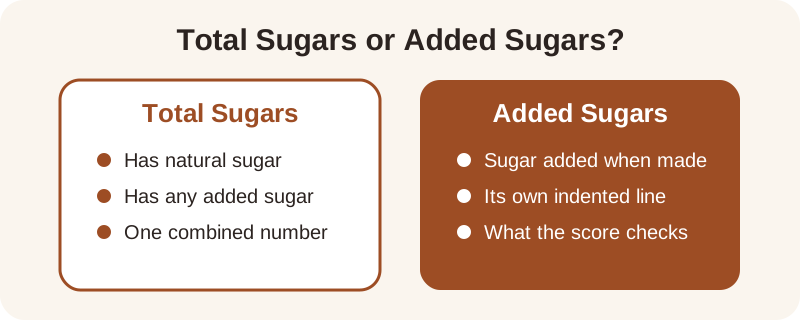
On a US Nutrition Facts panel, Total Sugars sits first and includes every kind of sugar in the food, whether it came from the apples in a sauce or the syrup stirred in afterward. Right under it, an indented line reads "Includes X g Added Sugars" — that second number only counts sugar added during processing.
A plain container of yogurt might show about 6 g of Total Sugars and 0 g Added Sugars — all of it from the milk. A flavored version of the same yogurt might show about 17 g Total Sugars with 11 g Added Sugars, meaning most of that sugar was mixed in rather than naturally part of the milk.
The serving size printed at the top of the panel changes both numbers, so it is worth checking before comparing two packages. A cereal that lists 9 g Added Sugars per a small serving can still add up to a larger number once you pour a bowl that is two or three servings, even though the per-serving figure on the front of the box never changes.
- Find the Total Sugars line in grams.
- Look for the indented "Includes … Added Sugars" line underneath it.
- Note the Added Sugars grams on their own — that's the figure worth comparing between products.
- Scan the ingredient list to see which words on it match that number.
Which ingredient names mean added sugar?
Added sugar shows up in an ingredient list under dozens of names, not just "sugar." Cane sugar, corn syrup, high-fructose corn syrup, dextrose, maltose, honey, agave nectar, molasses, brown rice syrup and fruit juice concentrate are all forms of added sugar, even though only one of them actually contains the word "sugar."
| Family | Common names on a label |
|---|---|
| Syrups | corn syrup, high-fructose corn syrup, brown rice syrup, maple syrup |
| Simple sugars | dextrose, sucrose, fructose, maltose, glucose |
| Concentrates and nectars | fruit juice concentrate, agave nectar |
| Traditional sweeteners | honey, molasses, cane sugar, evaporated cane juice |
Ingredients are listed by weight, heaviest first, so a name near the top of a short list usually means a bigger share of the food. On a long ingredient list, though, three or four different sugar names scattered through the middle can add up to more than a single name sitting near the top. A sauce or a dressing is a common place to see this pattern, since a few spoonfuls of corn syrup, honey and cane sugar can each sit below the salt and still total more than the tomatoes.
How does added sugar affect a meal's score?
In the PCOS Weight Loss meal score, added sugar makes up 20% of the total, alongside protein and fiber at 30% each and quality — how processed the food is — at 20%. The added-sugar reference is a flat 12 g, which is the reference this part of the score uses rather than a target to stay under, and lower added sugar scores higher against it.
Take two breakfasts with similar calories: a granola with about 14 g of added sugar scores lower on that part of the score than a bowl of overnight oats with chia, which is built with no added sugar stirred in. The other three parts of the score — protein, fiber and quality — still carry their own weight, so a meal with a little added sugar and plenty of protein and fiber can still land in a similar range overall. A snack like edamame with sea salt has no added sugar to track on a label at all, which is part of why it scores at the top of the scale. The four parts are combined unrounded, and only the final score gets rounded for display. You can test your own plate in the meal score calculator, and the full math behind all four parts is laid out on the how the score works page.
Checking a label this way takes a minute by hand, and it is the same reading the food scanner does automatically when you photograph a packaged item — pulling the Added Sugars figure straight into that part of the score alongside protein, fiber and quality, with no label-flipping required.
Does sugar from fruit or milk count as added sugar?
No — the Added Sugars line only counts sugar put in during processing, so the fructose naturally in a whole apple or the lactose naturally in a glass of milk stays out of it. A plain Greek yogurt or an apple with almond butter can both show sugar on the Total Sugars line with a 0 g Added Sugars line underneath.
Fruit juice concentrate is the exception worth remembering: once it's pulled out of the fruit and added into another food as a sweetener, it counts as added sugar on the label, even when the ingredient name just reads "apple juice concentrate" or "white grape juice concentrate." The same logic applies to dried fruit purees sold as sweeteners — once a food is processed specifically to sweeten something else, it moves from the "natural sugar" side of the ledger onto the Added Sugars line, regardless of its origin.
This is also why two foods with identical Total Sugars numbers can land in very different places on a meal's score. A piece of fruit and a packet of fruit snacks might both list 14 g of Total Sugars, but the fruit's Added Sugars line reads 0 g while the fruit snacks' line reads closer to 12 g — a difference that only shows up once you look past the combined total and down at the indented figure underneath it.
Frequently asked questions
What's the difference between Total Sugars and Added Sugars on a label?
Total Sugars counts every gram of sugar in a food, including what's naturally in fruit or milk. Added Sugars, indented underneath it, counts only sugar put in during processing — that's the narrower, more useful number when comparing two similar products.
Which ingredient names mean a food has added sugar?
Dozens of names cover added sugar, including cane sugar, corn syrup, high-fructose corn syrup, dextrose, maltose, honey, agave nectar, molasses, brown rice syrup and fruit juice concentrate. None of them say simply "sugar," which is why scanning the full ingredient list matters more than searching for one word.
Does natural sugar in fruit or milk count as added sugar?
No. The Added Sugars line only reflects sugar added while a food is made, so the fructose in a whole apple or the lactose in milk stays off that line entirely. Those sugars still appear in the Total Sugars number above it.
How much does added sugar affect a meal's score?
Added sugar is 20% of the meal score, alongside protein and fiber at 30% each and quality at 20%. The score compares added sugar to a flat 12 g reference, and lower added sugar scores higher against that reference.
Why do some sugar-free labels still have a low meal score?
A low or zero Added Sugars line only covers one part of the score. The same food can still score lower overall if it's light on protein and fiber, or if it's an ultra-processed item in the quality part of the score.
General nutrition information, not medical advice. Figures are estimates. Talk to a doctor or dietitian about your own needs.