 PCOS Weight Loss
What Counts as Processed Food? A Meal Score Guide
An explanation of the three processing tiers the meal score uses — minimally processed, processed and ultra-processed — with worked examples of how each one changes the quality part of a score.
Published
Quick answer
What counts as processed food depends on how much was added or changed: minimally processed (apples, oats), processed (canned beans, bread) and ultra-processed (chips, soda) are the three tiers the meal score uses for its quality part.
Key takeaways
- The meal score sorts food into three tiers: minimally processed, processed and ultra-processed
- Quality is 20% of the meal score; protein and fiber are each 30% and added sugar is 20%
- Tiers are weighted by the calories each one contributes to a plate, not by ingredient count
- A long ingredient list isn't the same test as the tier a food lands in
- A lower quality score is one of four numbers, not a verdict on the whole plate
What counts as processed food comes down to how much was added or changed before it reached your plate, not just whether it touched a can opener or a freezer. The meal score sorts food into three tiers and weights each one by calories to build the quality part of a meal's score.
How processed is a food, exactly?
A food's tier depends on how many ingredients were added to it and how far it moved from its starting form. Minimally processed food has had little done to it beyond washing, cutting, freezing or plain cooking. Processed food has a few ingredients added, often to season or preserve it. Ultra-processed food has several added ingredients, including some rarely found in a home kitchen.
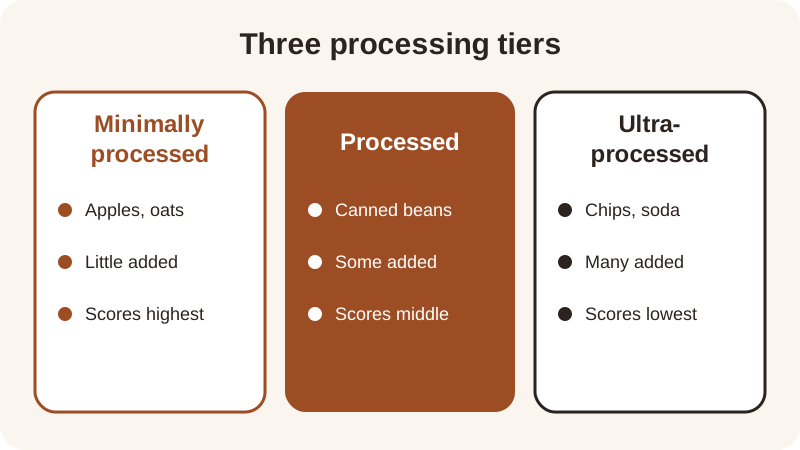
Minimally processed food examples include a plain apple, raw chicken breast, frozen broccoli with nothing added, and plain rolled oats. A can of beans in water and salt, a loaf of sliced wholegrain bread, or a block of cheese usually sits in the processed tier. A flavored instant noodle cup, a bag of flavored chips, or a bottle of soda usually sits in the ultra-processed tier.
How does processing change a meal's score?
The meal score runs from 0 to 10 and combines four parts: protein and fiber are each 30% of it, added sugar is 20%, and quality — how processed the food is — is the remaining 20%. Inside the quality part, minimally processed food counts 1.0, processed food counts 0.6, and ultra-processed food counts 0.15, weighted by the calories each tier contributes to the plate rather than by how many separate foods are on it.
Say a bowl gets most of its calories from turkey and beans — both minimally processed — and a smaller share from a canned tomato sauce with a few added ingredients, which sits in the processed tier. If roughly eight-tenths of the calories come from the minimally processed share and two-tenths from the processed share, the quality part works out to about 0.8 × 1.0 plus 0.2 × 0.6, or around 0.92 out of 1.0, before it's combined with the other three parts. The four parts are combined unrounded, and only the final number that lands on the 0–10 scale gets rounded for display. The full method is laid out on the how the score works page.
What does this look like with a real meal?
Turkey Chili scores 9.3 out of 10 on the recipe page, built from about 36 g of protein and 13 g of fiber across about 480 kcal — both above the score's references of 7 g of protein and 2 g of fiber per 100 kcal. Most of its calories come from turkey, beans and tomatoes, which land in the minimally or processed tiers, so the quality part of its score sits high alongside the protein and fiber parts.
Compare that with a flavored instant noodle cup around the same calories. It typically carries less protein and fiber per 100 kcal, the score's flat reference of 12 g of added sugar can already be partly used up by one serving, and its ingredients usually sit in the ultra-processed tier. All four parts land lower there, which is why the total comes out well under a bowl of chili — not because one food is labeled better, just because the four numbers behind it differ.
| Tier | Quality weight (per the score) | Typical examples |
|---|---|---|
| Minimally processed | 1.0 | Apples, oats, chicken breast, frozen vegetables |
| Processed | 0.6 | Canned beans, sliced bread, cheese |
| Ultra-processed | 0.15 | Flavored chips, candy, sugary cereal, soda |
Other recipes on the site show the same pattern. Lentil & Spinach Soup scores 9.2 with 20 g of protein and 14 g of fiber across about 340 kcal, built mostly from minimally processed lentils and spinach. Overnight Oats with Chia scores 7.6 — still a solid number, with its protein and fiber parts doing most of the work even though the score's references are general nutrition references rather than clinical targets to hit exactly.
Does a lower quality score mean skipping that food?
No. The quality part is one-fifth of the meal score, not a verdict on the whole plate. A food that lands in the ultra-processed tier can still sit next to a protein-dense side or a high-fiber vegetable, and those parts move the score on their own terms. The score describes what's in a meal across four numbers — it doesn't rank the food itself.
If you want to see how a specific plate adds up, type it into the meal score calculator or take a photo in the app and check the quality ring next to the other three. Nutrition figures pulled from a meal photo are estimates, and the portion stays editable on the score screen so you can adjust it before the four parts are calculated. For more on where the line between the tiers sits, the ultra-processed food guide goes through it in more depth.
Frequently asked questions
What counts as processed food in the meal score?
The score sorts food into three tiers by how much was added or changed: minimally processed (little done beyond washing, cutting or plain cooking), processed (a few added ingredients, often for seasoning or preserving) and ultra-processed (several added ingredients rarely found in a home kitchen). Each tier counts differently toward the quality part of a meal's score.
Does canned or frozen food count as processed?
It depends on what else is in the can or bag. Frozen vegetables with nothing added, or beans canned in water and salt, usually sit in the minimally processed or processed tier. The tier comes from what was added, not from the fact that it was canned or frozen.
Why does ultra-processed food score lower on quality?
In the quality part of the meal score, minimally processed food counts 1.0, processed food counts 0.6 and ultra-processed food counts 0.15, by calories. Quality is one-fifth of the total meal score, so a lower quality number pulls the overall score down but doesn't set it alone.
Can a meal still score well with some processed food in it?
Yes. The four parts — protein, fiber, added sugar and quality — are combined unrounded, so a meal with a small processed ingredient alongside protein-dense, high-fiber foods can still land with a high total score. The quality part only reflects the calories that come from each tier.
General nutrition information, not medical advice. Figures are estimates. Talk to a doctor or dietitian about your own needs.