 PCOS Weight Loss
Whole Grains vs Refined Grains: Fiber Differences
A plain comparison of how much fiber whole grains keep and refined grains lose per 100 calories, with a worked meal-score example.
Published
Quick answer
Whole grains vs refined grains fiber: whole grains keep the bran and germ, so they carry more fiber per 100 calories. Whole wheat bread and oats run about 2 g fiber per 100 kcal; white bread and white rice run under 1 g.
Key takeaways
- Whole wheat bread runs about 2.2 g fiber per 100 kcal; white bread runs about 0.7 g.
- Brown rice has about 1.6 g fiber per 100 kcal; white rice has about 0.3 g.
- The meal score's fiber reference is 2 g fiber per 100 kcal — a general reference, not a target.
- Quinoa and oats are whole grains that land close to that fiber reference on their own.
- A refined grain can still be minimally processed; refining and processing level are not the same thing.
Whole grains vs refined grains fiber differences come down to the bran and germ: refining strips those layers away, so a cup of white rice ends up with a fraction of the fiber a cup of brown rice has. Per 100 calories, that gap is large enough to move the fiber part of a meal's score.
Neither type of grain is labeled good or bad here. The numbers below just show what each one adds to a meal, so you can see the effect before you decide what to put on the plate.
What makes whole grains higher in fiber than refined grains?
A grain kernel has three layers: the bran on the outside, the germ at the base, and the starchy endosperm that makes up most of the middle. Fiber is concentrated in the bran, with a smaller amount in the germ. Refining a grain means stripping off the bran and germ and milling only the endosperm, which is why a refined grain keeps its calories but loses most of its fiber.
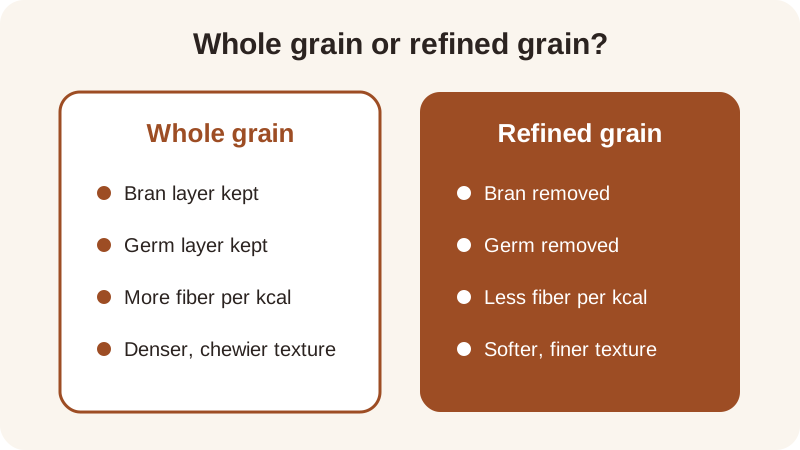
This is also why a food label can look different from what the ingredient name suggests. "Wheat bread" without the word "whole" in front of flour is usually a refined-grain product with the bran milled out, even though it is tan rather than white.
How much fiber do common grains have per 100 calories?
The table below uses ordinary, typical values for a stated portion, rounded. Brand and cooking method shift these slightly, but the gap between whole and refined versions of the same grain stays wide.
| Grain, typical portion | Fiber per 100 kcal (about) |
|---|---|
| Oats, dry, half cup | 2.7 g |
| Whole wheat bread, 1 slice | 2.2 g |
| Quinoa, cooked, 1 cup | 2.3 g |
| Brown rice, cooked, 1 cup | 1.6 g |
| White bread, 1 slice | 0.7 g |
| White rice, cooked, 1 cup | 0.3 g |
Oats, whole wheat bread and quinoa all land near or above the meal score's fiber reference of 2 g of fiber per 100 kcal. White bread and white rice sit well below it. That reference is a general nutrition reference the score uses for comparison, not a clinical target for any individual meal.
Does switching from a refined grain change a meal's score?
Fiber is 30% of the meal score, so the grain in a meal can move the total even when nothing else changes. The Grilled Chicken & Quinoa Salad recipe has about 42 g protein, 8 g fiber and 460 kcal for a meal score of 9.1, built around quinoa rather than white rice.
Swap that quinoa for an equal-calorie portion of white rice and the protein and calories stay roughly the same, but the fiber grams drop toward the white rice figure in the table above. Since fiber is a third of the score, the fiber part would fall while protein, added sugar and quality stay where they were — the total would move down, even though the chicken and vegetables didn't change at all.
You can test a swap like this yourself with the meal score calculator: enter the same protein and calories, change only the fiber grams, and watch which part of the score moves.
Is a refined grain only about losing fiber?
Fiber is the clearest difference, but it isn't the only one. Refining also removes most of the germ's protein and leaves a food that, by itself, contributes less to both the protein and fiber parts of a meal score. A refined grain isn't automatically lower on the quality part, though — that depends on how processed the finished food is, not on whether the grain was refined.
Plain white rice or plain white pasta, cooked at home with nothing else added, counts as minimally processed (1.0 by calories) in that part of the score. A packaged snack made from refined grain plus syrups, oils and additives would usually fall into the processed or ultra-processed bands (0.6 or 0.15), which is a separate effect from the fiber drop.
For a meal built mostly around a refined grain, the easiest lever is often what sits alongside it rather than the grain itself. Lentils, beans, vegetables or a fiber-dense topping add grams without changing the base. The Overnight Oats with Chia recipe shows the other direction — oats are already a whole grain, and chia on top pushes fiber to about 10 g for 380 kcal, for a meal score of 7.6.
How do you track grain fiber without doing the math by hand?
You don't have to multiply grams by 100 for every plate. The fiber tracker scores each meal's fiber against the same 2 g per 100 kcal reference used across the app, whether you log a bowl of oats, a quinoa salad or a sandwich on white bread.
If you'd rather skip calories and macros altogether, Gentle Mode scores the same meal on protein, fiber, added sugar and quality with no calorie count and no scale anywhere in the app. Either way, the arithmetic behind the score — and the fiber reference it's compared against — is explained in full on the how the score works page.
Frequently asked questions
Why do whole grains have more fiber than refined grains?
Fiber sits mostly in the bran and germ layers of a grain kernel. Refining removes those layers and keeps only the starchy endosperm, so a refined grain like white rice or white flour ends up with a fraction of the fiber per 100 calories that the whole version has.
Is brown rice always higher in fiber than white rice?
Typical brown rice runs about 1.6 g of fiber per 100 kcal, compared with about 0.3 g for white rice, because the bran layer stays on. Exact figures vary slightly by brand and cooking method, so a label or the app's scanner gives a more precise read.
Does a refined grain automatically score lower on the meal score?
A refined grain usually lowers the fiber part of the score, which is 30% of the total and uses a reference of 2 g fiber per 100 kcal. The other three parts — protein, added sugar and quality — depend on the rest of the meal, not the grain alone.
Can I raise the fiber of a meal built on a refined grain?
Pairing a refined grain with vegetables, legumes or a fiber-dense topping adds grams without changing the grain itself. The fiber tracker shows the running total for a meal as you add items, which makes it easy to see the effect.
General nutrition information, not medical advice. Figures are estimates. Talk to a doctor or dietitian about your own needs.