 PCOS Weight Loss
High Protein Pasta Swaps: The Numbers
A look at chickpea, lentil and edamame pasta next to regular pasta, with protein and fiber per 100 calories and how each swap moves the meal score.
Published
Quick answer
High protein pasta swaps include chickpea, lentil and edamame pasta, each with more protein and fiber per 100 calories than regular pasta. Adding a protein side like tofu, turkey or edamame to any pasta also raises a meal's score without changing the noodles.
Key takeaways
- Chickpea and lentil pasta run close to double the protein per 100 calories of regular pasta.
- Edamame pasta is among the highest-protein noodle swaps, with added fiber too.
- Whole wheat pasta raises fiber more than protein compared to regular pasta.
- Adding a topping like tofu, egg or lentils raises a pasta meal's score without swapping noodles.
- The protein reference is 7 g per 100 kcal and the fiber reference is 2 g per 100 kcal — general references, not targets.
The most common high protein pasta swaps are chickpea pasta, lentil pasta and edamame pasta, each of which carries noticeably more protein and fiber per 100 calories than regular wheat pasta. A simpler swap — keeping the pasta and adding a protein topping — can move a meal's score just as much.
None of these noodles is better or worse to eat than another; the differences below are about what each one adds to the protein and fiber parts of a meal's score, which together make up 60% of the total.
Which pasta swaps have the most protein per 100 calories?
Regular pasta, cooked, about 1 cup (roughly 140 g), runs about 200 kcal with about 7 g protein and about 2 g fiber — that works out to about 3.5 g protein and about 1 g fiber per 100 kcal. Legume-based pastas change both numbers at once.
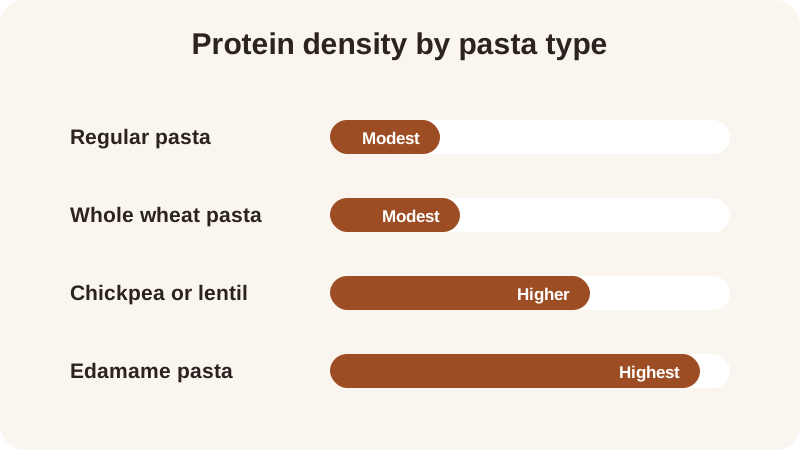
Chickpea pasta, cooked, about 1 cup (roughly 170 g), runs about 190 kcal with about 13 g protein and about 8 g fiber — close to 6.8 g protein and 4.2 g fiber per 100 kcal. Lentil pasta lands in a similar range: about 200 kcal, about 13 g protein, about 8 g fiber per cup, or roughly 6.5 g protein and 4 g fiber per 100 kcal. Edamame pasta runs higher still — about 190 kcal, about 24 g protein, about 11 g fiber per cup, which is about 12.6 g protein and 5.8 g fiber per 100 kcal, well past the score's 7 g protein and 2 g fiber per 100 kcal references. Those references are general nutrition references this score uses, not a target to hit at every meal.
| Pasta, cooked (about 1 cup) | Protein per 100 kcal (about) | Fiber per 100 kcal (about) |
|---|---|---|
| Regular pasta | 3.5 g | 1 g |
| Whole wheat pasta | 4 g | 2.5 g |
| Lentil pasta | 6.5 g | 4 g |
| Chickpea pasta | 6.8 g | 4.2 g |
| Edamame pasta | 12.6 g | 5.8 g |
Does a pasta swap also change the fiber part of the score?
Yes — for legume pastas, fiber moves almost as much as protein does. Regular pasta's roughly 1 g fiber per 100 kcal is well under the score's 2 g per 100 kcal fiber reference, while chickpea, lentil and edamame pasta all land above it, which is the bigger shift for the fiber part of the meal score.
Whole wheat pasta is the smallest change of the group — it raises fiber per 100 kcal from about 1 g to about 2.5 g, close to the reference, but protein stays about the same as regular pasta. It is a fiber-leaning swap more than a protein one.
What if you keep regular pasta and add protein instead?
Keeping the noodles and adding a protein-dense topping changes the same two parts of the score without swapping anything in the pantry. A few options, by the numbers they typically add:
- About half a cup of cooked lentils adds roughly 9 g protein and 8 g fiber for about 115 kcal — similar fiber math to the Lentil & Spinach Soup recipe.
- About half a cup of shelled edamame adds roughly 9 g protein and 4 g fiber for about 95 kcal, as in the Edamame with Sea Salt recipe.
- About 3 oz of cooked ground turkey adds roughly 22 g protein for about 140 kcal, closer to the approach used in the Turkey Chili recipe.
- About a third of a cup of cottage cheese stirred into sauce adds roughly 9 g protein for about 70 kcal, with very little fiber.
Any of these stacks on top of regular pasta's own protein and fiber, moving the meal's totals even if the noodles themselves do not change. The protein per 100 calories guide walks through the arithmetic in more detail if you want to try other combinations.
How much does a pasta swap move the actual meal score?
Take a plain regular-pasta dinner: about 2 cups cooked pasta with a simple tomato sauce, roughly 420 kcal, about 14 g protein and about 5 g fiber — around 3.3 g protein and 1.2 g fiber per 100 kcal, both below their references. Swap in chickpea pasta at the same portion and the same meal runs closer to 26 g protein and 16 g fiber for a similar calorie count, pushing both the protein and fiber parts of the score up at once, since those two parts together make up 60% of the total (added sugar is 20% and quality is 20%). The four parts are combined unrounded and only the final number is rounded for display.
If you want to see what either version scores exactly, logging it in the meal score calculator with your own portion and sauce will give you the real number rather than an estimate from this page. A meal logged by photo in the app gives the same four-part breakdown, with the portion editable on the score screen before you save it.
Frequently asked questions
Is chickpea pasta actually higher in protein than regular pasta?
Yes, by the numbers. A cup of cooked chickpea pasta runs about 190 kcal with about 13 g protein, close to 7 g per 100 kcal — near the meal score's protein reference. Regular pasta cooked the same way is closer to 3.5 g per 100 kcal, so chickpea pasta lifts the protein part of a meal's score noticeably.
Does whole wheat pasta have more protein than regular pasta?
Only slightly. Whole wheat pasta's bigger difference is fiber — about 5 g per cup versus about 2 g for regular pasta — while protein stays close to the same per 100 kcal. It raises the fiber part of a score more than the protein part.
What can I add to regular pasta instead of swapping the noodles?
Toppings like cottage cheese, a soft egg, edamame, tofu or lentils add protein grams without changing the pasta itself. Stirring about half a cup of cooked lentils into a sauce adds roughly 9 g protein and 8 g fiber for about 115 kcal.
Does a pasta swap actually change the meal score?
It changes the protein and fiber parts, which together make up 60% of the score. Swapping to a higher-protein, higher-fiber pasta or adding a protein topping moves those two parts toward their references; added sugar and quality stay about the same either way.
Is lentil pasta higher in fiber than chickpea pasta?
They land close together. A typical cooked cup of either runs about 8 g fiber for roughly 190-200 kcal, which works out to around 4 g fiber per 100 kcal for both — well above regular pasta's roughly 1 g per 100 kcal.
General nutrition information, not medical advice. Figures are estimates. Talk to a doctor or dietitian about your own needs.