 PCOS Weight Loss
High Fiber Vegetables List (Fiber Per 100 Calories)
A ranked look at which vegetables carry the most fiber per 100 calories, with portions, a scored-recipe comparison and two links to try the numbers yourself.
Published
Quick answer
A high fiber vegetables list ranks foods like artichokes, Brussels sprouts and broccoli by fiber per 100 calories, the same measure the meal score's fiber part uses in PCOS Weight Loss.
Key takeaways
- Artichokes, Brussels sprouts and spinach rank near the top of a high fiber vegetables list by fiber per 100 calories.
- The meal score's fiber reference is about 2 g of fiber per 100 kcal, a general reference, not a target.
- Sweet potato carries real fiber but a lower per-100-kcal number because it has more calories per cup.
- Pairing high-fiber vegetables with a protein food like lentils or tofu lifts two parts of the score at once.
A high fiber vegetables list is really a list of fiber per 100 calories, since fiber density is what the meal score's fiber part looks at, not total fiber for a huge portion. Here are the vegetables that come out highest, with rough portions and grams.
Which vegetables are highest in fiber?
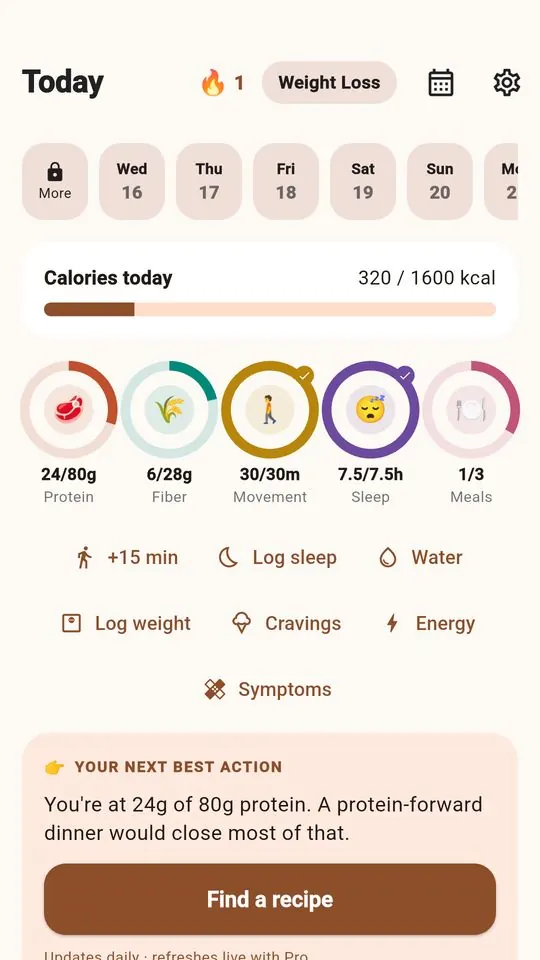
Fiber per 100 kcal is the fiber in a food divided by its calories, times 100 — the same math the meal score uses for its fiber part. It lets a small, low-calorie vegetable like spinach compare fairly against a starchier one like sweet potato.
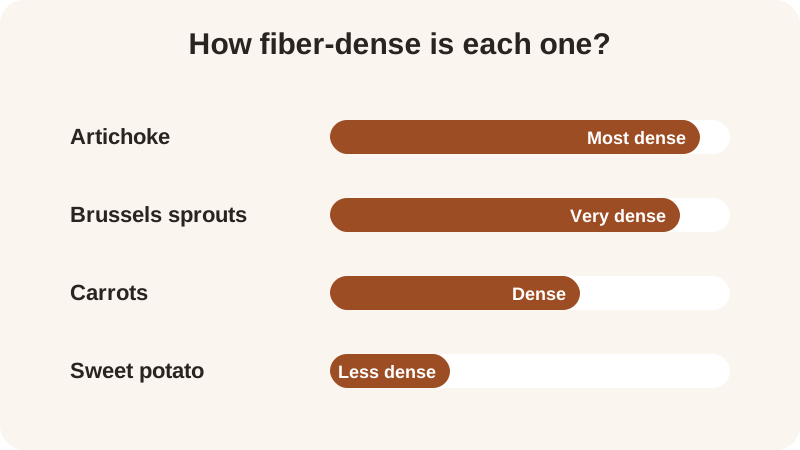
Here are typical portions with their fiber, calories and the per-100-kcal figure. These are ordinary values for common preparations, rounded, and worth treating as "about" rather than exact — a different variety, a different cooking method or a different scale will shift any of these numbers a little.
| Vegetable, typical portion | Fiber (about) | Fiber per 100 kcal (about) |
|---|---|---|
| Artichoke, cooked, 1 medium (~60 kcal) | 6 g | 10 g |
| Brussels sprouts, cooked, 1 cup (~38 kcal) | 4 g | 10 g |
| Spinach, cooked, 1 cup (~40 kcal) | 4 g | 10 g |
| Broccoli, cooked, 1 cup (~30 kcal) | 3 g | 9 g |
| Carrots, raw, 1 cup chopped (~45 kcal) | 3.5 g | 7 g |
| Green peas, cooked, ½ cup (~67 kcal) | 4 g | 6 g |
| Sweet potato, baked with skin, 1 medium (~135 kcal) | 4 g | 3 g |
None of these is better or worse to eat — the table only shows which ones move the fiber part of a score the most per calorie they add. A side of sweet potato still adds 4 g of fiber; it just adds more calories alongside it, which is why the per-100-kcal column, not the raw gram count, is what actually changes the score.
How much fiber is in a typical vegetable serving?
A single serving of most vegetables lands between 2 and 6 g of fiber, so it usually takes two or three servings in one meal to meaningfully shift a meal's fiber part on its own. A plate with a cup of broccoli (about 3 g) and a cup of carrots (about 3.5 g) gives roughly 6.5 g of fiber for around 75 kcal — about 8.7 g per 100 kcal, well above the meal score's fiber reference of 2 g per 100 kcal.
For context on totals across a whole meal rather than just the vegetable side, the how many grams of fiber in a meal guide walks through the same math for full plates, and the high fiber lunch ideas page scores several combinations built around vegetables and a protein food. Both are useful if the per-vegetable table above raises the question of what a whole day's worth of meals adds up to.
How do high-fiber vegetables change a meal's score?
Fiber is 30% of the meal score, weighted against a reference of about 2 g of fiber per 100 kcal — a general reference the score uses, not a clinical target. Vegetables with a high fiber-per-100-kcal figure push that part of the score up quickly because they add fiber without adding many calories.
A few of the site's twelve recipes show this in practice. Lentil & Spinach Soup carries 14 g of fiber across 340 kcal — about 4.1 g per 100 kcal — and scores 9.2 out of 10. Chickpea & Feta Salad has 12 g of fiber in 420 kcal, about 2.9 g per 100 kcal, and scores 8.3. Tofu & Vegetable Stir-Fry comes in at 9 g of fiber over 420 kcal, close to 2.1 g per 100 kcal, also landing at 8.3. All three sit above the 2 g reference, and all three lean on vegetables for a large share of that fiber. You can see the full recipe and numbers for each: Lentil & Spinach Soup, Chickpea & Feta Salad and Tofu & Vegetable Stir-Fry.
What pairs well with high-fiber vegetables for a higher score?
Fiber is only one of four parts of the score — protein, added sugar and quality (how processed the food is) make up the rest — so a plate of vegetables alone usually needs a protein food alongside it to lift the protein part too. Turkey Chili pairs ground turkey with beans and vegetables for 13 g of fiber and 36 g of protein across 480 kcal, and it scores 9.3, the kind of result that comes from strong numbers on two parts of the score at once rather than one. A simpler plate, like steamed broccoli next to a portion of grilled chicken, follows the same pattern: the vegetable lifts fiber, the chicken lifts protein, and the two together move the score more than either would alone.
Try swapping vegetables in or out of a meal you already eat using the meal score calculator, or log it by photo in the app, where the fiber ring tracks grams of fiber alongside protein, movement, sleep and meals. In Gentle Mode there's no calorie count or scale anywhere, just the fiber and protein numbers behind each meal — useful if the per-100-kcal math above is more detail than you want to track day to day. The fiber tracker scores a plate of vegetables the same way as the examples here, whether it's typed in by hand or scanned from a photo, and the portion stays editable on the score screen either way.
Frequently asked questions
What vegetable has the most fiber per 100 calories?
Among common vegetables, artichoke, Brussels sprouts and cooked spinach come out near the top, each running roughly 9 to 10 g of fiber per 100 kcal. That is well above the meal score's fiber reference of about 2 g per 100 kcal, which is a general reference rather than a target.
Do frozen vegetables have as much fiber as fresh ones?
Yes, roughly. Freezing does not remove fiber, so a cup of frozen broccoli or peas carries about the same grams of fiber and the same fiber per 100 kcal as the fresh version, though cooking method and added sauces can change the calorie side of the math.
Why does sweet potato score lower on fiber than broccoli?
A medium sweet potato has real fiber, but it also carries more calories per cup than broccoli or spinach. Dividing fiber by calories gives a lower fiber-per-100-kcal number, which is what the meal score's fiber part actually measures.
Is there a fiber amount a meal should hit?
The app does not set a target. Its fiber part compares a meal's fiber per 100 kcal against a reference of about 2 g, and that reference is a general nutrition reference, not a clinical threshold or a number to chase exactly.
Can vegetables alone bring a meal to a high score?
Fiber is only 30% of the meal score; protein is another 30%. A vegetable side can push the fiber part up a lot, but a meal usually needs a protein food alongside it, like chicken, lentils, tofu or beans, to lift the protein part too.
General nutrition information, not medical advice. Figures are estimates. Talk to a doctor or dietitian about your own needs.