 PCOS Weight Loss
High Fiber Snacks With Protein, Scored
A look at which everyday snacks pair protein and fiber per 100 calories, with worked examples from three scored recipes and ways to track snacks with or without counting calories.
Published
Quick answer
High fiber snacks with protein pair a fiber-forward food with a protein-forward one — edamame, cottage cheese with cucumber, or apple with almond butter all show up well on the protein and fiber per 100 calories the meal score uses.
Key takeaways
- Edamame with Sea Salt works out to about 9 g protein and 4 g fiber per 100 kcal.
- The score's references are 7 g protein and 2 g fiber per 100 kcal — general references, not snack targets.
- Cottage cheese with cucumber is protein-forward; apple with almond butter is more fiber-forward.
- Pairing a protein food with a fiber food lifts both parts of a snack's score at once.
- Gentle Mode scores a snack's protein, fiber, added sugar and quality with no calories shown.
High fiber snacks with protein are the ones that pair a fiber-forward food with a protein-forward one, so a single snack lifts both parts of the meal score instead of just one. Edamame, cottage cheese with cucumber, and an apple with almond butter are three worth knowing the numbers on.
What makes a snack score well on protein and fiber?
The meal score runs from 0 to 10 and is built from four parts: protein and fiber each count for 30% of the score, added sugar counts for 20%, and quality — how processed the food is — counts for the remaining 20%. The protein part compares a food's protein per 100 kcal to a reference of 7 g, and the fiber part compares fiber per 100 kcal to a reference of 2 g. Both are general references this score uses for scoring, not targets for any one snack to hit.
Added sugar and quality matter for snacks too, even though they carry less weight in the score. A flavored yogurt cup or a granola bar can carry several grams of added sugar against the score's flat reference of 12 g, and a packaged bar milled from several processed ingredients counts differently in the quality part than a handful of edamame in the pod. None of that makes either food off-limits — it just changes where the score lands.
A snack can lift its score two ways: carrying more protein and fiber per 100 calories, or carrying the same grams of each over fewer calories. That's part of why a small, dense snack — a cup of edamame, a half-cup of cottage cheese — can score as well as, or better than, a larger one built around a lower-density food.
Which snacks give the most protein and fiber per 100 calories?
Here's how some everyday snacks compare once you divide grams of protein or fiber by calories and multiply by 100 — the same math running behind the meal score.
| Snack | Protein per 100 kcal (about) | Fiber per 100 kcal (about) |
|---|---|---|
| Edamame with Sea Salt | 9 g | 4 g |
| Cottage Cheese & Cucumber | 11 g | 1 g |
| Apple with Almond Butter | 3 g | 3 g |
| Roasted chickpeas, about 1/3 cup | 5 g | 3 g |
| Chia pudding, about 1/2 cup | 4 g | 5 g |
| Hummus with carrot sticks, about 1/2 cup | 4 g | 3 g |
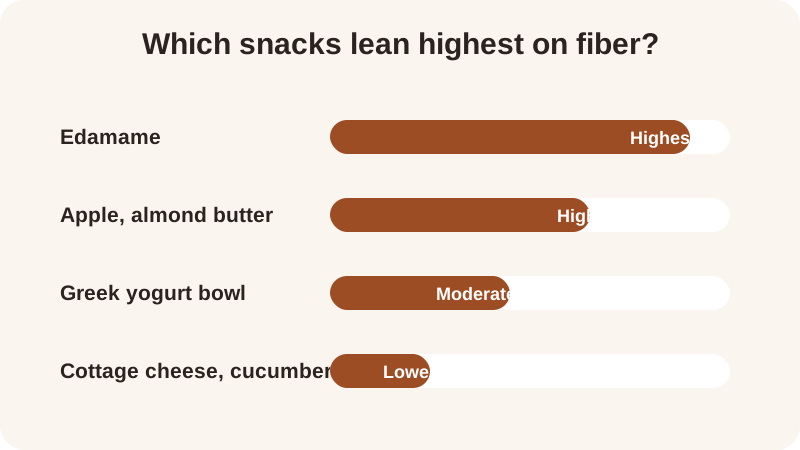
None of these numbers makes one snack better than another — they just show which part of the score each one is pulling up. Cottage cheese with cucumber leans hard on protein per 100 kcal; chia pudding leans hard on fiber per 100 kcal; chickpeas and hummus sit somewhere in between, carrying a bit of both.
How does a real snack compare to the score's references?
Take Edamame with Sea Salt: about 17 g of protein, 8 g of fiber, and 190 kcal. Divide each by calories and multiply by 100: roughly 8.9 g of protein per 100 kcal and 4.2 g of fiber per 100 kcal — both above the score's references of 7 g and 2 g. That's a large part of why this snack's meal score lands at 10.0 on the recipe page.
Cottage Cheese & Cucumber runs about 20 g protein and 2 g fiber over 180 kcal — roughly 11.1 g protein per 100 kcal, well above the protein reference, but only about 1.1 g fiber per 100 kcal, under the fiber reference. Its meal score of 8.5 reflects a snack that's well ahead on protein and a little behind on fiber.
Apple with Almond Butter flips that pattern: about 6 g protein and 6 g fiber over 220 kcal works out to roughly 2.7 g protein and 2.7 g fiber per 100 kcal — under the protein reference, just over the fiber one. Its score of 6.8 sits a little lower, mainly on the protein side rather than the fiber side.
How do you track snacks without counting calories?
Gentle Mode has no calories and no scale anywhere in the app, so a snack still gets its meal score for protein, fiber, added sugar and processing without a calorie total attached to it. Weight Loss Mode shows calories, macros and a weight trend alongside the same score, for anyone who wants that view instead — both modes use the same four-part score underneath.
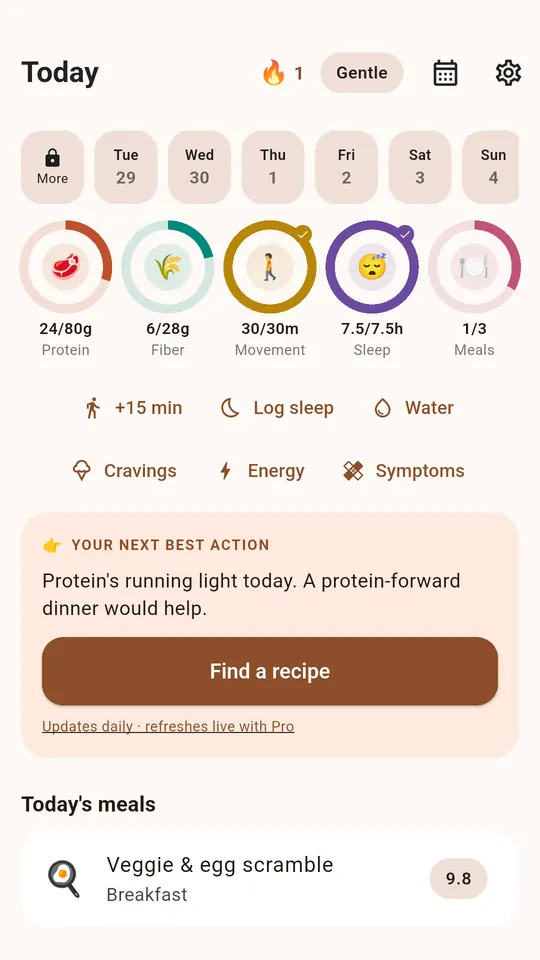
A photo of a snack through the food scanner gives an estimate of protein, fiber, added sugar and quality within a few seconds, scored the way the meal score page describes — those figures from a photo are estimates, not lab measurements. The fiber tracker keeps a running total of fiber across the day, snacks included, so it's easier to see where a handful of edamame or chickpeas is adding up alongside meals. Five rings — protein, fiber, movement, sleep and meals — sit on the same screen, so a snack's contribution shows up next to the rest of the day rather than in isolation.
What's one snack to try next?
If a snack is leaning heavy on protein and light on fiber — cottage cheese on its own, say — adding cucumber, berries, or a small handful of chickpeas moves the fiber number up without changing the protein much. If it's leaning the other way, like fruit on its own, a spoon of nut butter, a scoop of cottage cheese, or a few cubes of tofu adds protein grams to the same fiber-rich base.
Any of these combinations can be checked directly: enter the grams of protein, fiber, added sugar and calories into the meal score calculator to see exactly how a swap changes the four parts, or compare it against one of the twelve scored recipes on the site, each with its own 0–10 meal score already worked out.
Frequently asked questions
What counts as a high fiber snack with protein?
One that carries meaningful grams of both per calorie, not just a big number of one. Edamame, cottage cheese with cucumber, and apple with almond butter each pair a protein-forward food with a fiber-forward one, which is what lifts both the protein and fiber parts of a meal score.
How much protein and fiber should a snack have?
The meal score uses 7 g of protein and 2 g of fiber per 100 kcal as general references for scoring, not a target amount for any single snack. A snack can score well by leaning on one part more than the other, or by carrying some of both.
Is cottage cheese or an apple with almond butter better for fiber?
Apple with almond butter carries more fiber per 100 calories — about 3 g versus about 1 g for cottage cheese with cucumber. Cottage cheese runs well ahead on protein instead, at around 11 g per 100 kcal versus about 3 g for the apple pairing.
Can a snack score a 10 out of 10?
Yes — Edamame with Sea Salt scores 10.0 on the site's recipe pages, with about 17 g protein and 8 g fiber over 190 kcal. That works out to roughly 9 g protein and 4 g fiber per 100 kcal, both above the score's references.
How do you log a snack without counting calories?
Gentle Mode scores a snack's protein, fiber, added sugar and quality with no calorie total or scale shown anywhere in the app. A photo through the food scanner gives those estimates in a few seconds either way.
General nutrition information, not medical advice. Figures are estimates. Talk to a doctor or dietitian about your own needs.