 PCOS Weight Loss
How Much Added Sugar Is in Flavored Yogurt?
A practical breakdown of how much added sugar typical flavored yogurt cups and drinks carry, and how that number moves the added-sugar part of a meal's score.
Published
Quick answer
Flavored yogurt typically has about 11 to 17 grams of added sugar per container, which answers how much added sugar is in flavored yogurt for most brands; plain Greek yogurt with fruit usually has none.
Key takeaways
- Flavored Greek yogurt usually carries about 11-14 g added sugar per container; regular flavored yogurt runs about 15-17 g.
- The meal score's added-sugar reference is a flat 12 g, and lower added sugar scores higher against it.
- Plain yogurt with fresh fruit typically has close to 0 g added sugar, which raises that part of the score.
- Added sugar is 20% of the meal score; protein and fiber each count for 30%.
- The Nutrition Facts 'Added Sugars' line is more reliable than front-of-pack words like 'light' or 'fruit.'
How much added sugar is in flavored yogurt? Typically about 11 to 17 grams per container, depending on whether it's Greek-style or regular, and whether it's fat-free or whole milk.
How much added sugar is actually in flavored yogurt?
Flavor and added sugar track together more than the label design lets on. A fruit-on-the-bottom flavored Greek yogurt in a typical 5.3 oz cup usually carries about 11 to 14 g of added sugar, while a regular, non-Greek flavored yogurt of the same size often runs about 15 to 17 g, since it has less protein in the mix overall. A flavored yogurt drink made for kids, in a smaller 4 oz pouch, can still carry about 9 to 11 g.
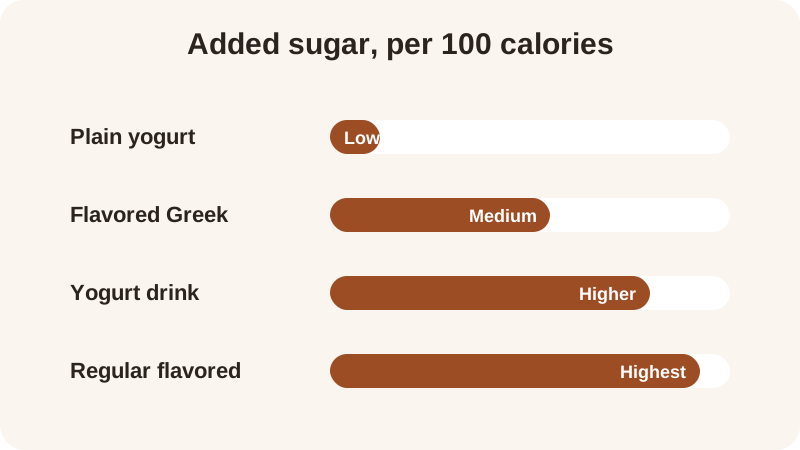
Plain yogurt — Greek-style or regular, unflavored — typically has about 0 g of added sugar; the sugar already on its label is naturally occurring lactose, not anything added in. That distinction only shows up on the Nutrition Facts panel's "Added Sugars" line, not in the product's name or front-of-pack wording. Stirring fresh or frozen fruit into a plain cup yourself brings along some natural sugar too, but the label difference between "stirred in by you" and "added at the factory" is exactly what the Added Sugars line is built to separate out.
| Yogurt, typical portion | Calories (about) | Added sugar (about) |
|---|---|---|
| Plain Greek yogurt, 5.3 oz | 130 kcal | 0 g |
| Flavored Greek yogurt, 5.3 oz | 150 kcal | 13 g |
| Regular flavored yogurt, 5.3 oz | 150 kcal | 16 g |
| Flavored yogurt drink, 4 oz | 100 kcal | 10 g |
How does that added sugar change the meal score?
Added sugar is 20% of the meal score, and the reference it uses is a flat 12 g — lower added sugar scores higher against that reference. It's a general nutrition reference the score uses, not a clinical target. A flavored Greek yogurt with about 13 g of added sugar sits right around that line, so its added-sugar part lands near the middle. A regular flavored yogurt with about 16 g sits above it, pulling that one part down further, even when the protein and fiber parts look fine on their own.
Protein and fiber each still count for 30% of the total, more than added sugar's 20%, and quality (how processed the food is) makes up the last 20%. A flavored yogurt with about 10 g of protein in 150 kcal works out to roughly 6.7 g per 100 kcal — close to the 7 g per 100 kcal protein reference the score uses — so a cup can still land in a reasonable overall range even with added sugar pulling that one part lower. The four parts are combined unrounded, and only the final number gets rounded for display, so small differences in any one part still show up in the total. Run a specific container's numbers through the meal score calculator to see all four parts side by side; how they're weighted is laid out on the how the score works page.
For context on where yogurt's protein sits compared with other foods people reach for at breakfast, the protein per 100 calories guide walks through the same per-100-kcal math used here, just applied to the protein part instead of added sugar.
How can you build a flavored-yogurt bowl with less added sugar?
Start from plain yogurt and add the flavor yourself rather than buying it pre-mixed. The Greek Yogurt Berry Bowl recipe uses about 24 g of protein, 6 g of fiber and 320 kcal, scoring 9.0 out of 10, partly because its sweetness comes from berries rather than a flavor syrup, which keeps added sugar low.
A side-by-side: a store-bought flavored Greek yogurt cup might have about 13 g of protein, 0 g of fiber and 13 g of added sugar in 150 kcal. Stirring plain Greek yogurt with a similar amount of berries instead can land closer to 17 g of protein, about 3 g of fiber, and close to 0 g of added sugar for the same calories. All four parts of the score move with that one swap, not just added sugar — the fiber part rises too, since fruit stirred in by hand brings fiber that a flavor syrup does not.
Is plain yogurt with fruit really different from flavored yogurt?
Mostly, because of where the sugar comes from. A half cup of fresh berries stirred into plain yogurt brings some natural sugar along with about 2 to 4 g of fiber, which adds to the fiber part of a meal's score. A flavor syrup mixed into store-bought yogurt brings sugar with no fiber at all, so it only moves the added-sugar part of the score, leaving fiber unchanged.
Neither version is labeled better or worse to eat — the score only shows which one is lower or higher on each of its four parts. If keeping an eye on added sugar across a day matters to you, Gentle Mode scores each meal from a photo without showing calories or a scale anywhere in the app, so that one part can be watched on its own. Weight Loss Mode shows the same four-part score alongside calories, macros and a weight trend, for anyone who wants those numbers visible too. Either way, nutrition figures pulled from a meal photo are estimates, so treating the grams here as a general range rather than an exact count is the more useful habit to build.
Frequently asked questions
How much added sugar is in a flavored Greek yogurt cup?
A typical 5.3 oz flavored Greek yogurt cup carries about 11 to 14 grams of added sugar alongside roughly 13 to 17 grams of protein. That added sugar counts toward the 20% added-sugar part of the meal score, measured against the flat 12 g reference the score uses.
Is plain yogurt lower in added sugar than flavored yogurt?
Yes. Plain yogurt, Greek or regular, typically has close to 0 grams of added sugar, since the sugar on its label is naturally occurring lactose. Flavored versions usually add somewhere between about 9 and 17 grams of added sugar per container to sweeten the fruit or vanilla flavor.
Does added sugar in yogurt change its meal score a lot?
It changes one of four parts. Added sugar is 20% of the meal score, with protein and fiber each at 30% and quality at 20%. A yogurt with added sugar near or below the flat 12 g reference scores higher on that part than one well above it.
How can I check the added sugar in a specific yogurt brand?
Check the 'Added Sugars' line on the Nutrition Facts panel rather than the ingredient list order or front-of-pack words like 'light' or 'fruit.' The grams listed there, compared against the container's calories, is the most reliable number to use across brands.
Are yogurt drinks higher in added sugar than yogurt cups?
Not always in total grams, since drinks come in smaller portions, but often yes per 100 calories, because they carry less protein for the same sweetness. Comparing the label's added sugar grams against the calorie count on that same container is the clearest way to check.
General nutrition information, not medical advice. Figures are estimates. Talk to a doctor or dietitian about your own needs.