 PCOS Weight Loss
High Fiber Lunch Ideas, Scored for Fiber and Protein
A practical look at high fiber lunch ideas, with fiber-per-100-calorie math for real lunches and links to scored recipes and the meal score calculator.
Published
Quick answer
High fiber lunch ideas that score well pair a fiber-dense base like lentils, chickpeas or vegetables with a protein source. Lentil & Spinach Soup and Chickpea & Feta Salad both score above 8 out of 10.
Key takeaways
- Fiber per 100 calories, not fiber per plate, is what the meal score's fiber part uses
- Lentil & Spinach Soup works out to about 4.1 g fiber per 100 kcal
- Adding chickpeas, lentils or beans to a salad raises fiber without changing the portion
- The fiber reference (2 g per 100 kcal) is a scoring reference, not a target to hit daily
- Gentle Mode tracks fiber and protein with no calories or scale shown
The highest-scoring high fiber lunch ideas pair a fiber-dense base — lentils, chickpeas, beans or a big pile of vegetables — with a protein source, so the fiber and protein parts of the meal score move up together. Lentil & Spinach Soup and Chickpea & Feta Salad both land near the top of the fiber list without needing a bigger portion.
What makes a lunch count as high fiber?
The meal score looks at fiber per 100 calories, not fiber per plate, so a small bowl of lentils can score better than a large bowl of something lower in fiber. The score's fiber reference is 2 g of fiber per 100 kcal — a general nutrition reference this score uses, not a clinical target.
Fiber is 30% of the meal score, the same weight as protein, with added sugar at 20% and quality — how processed the food is — at 20%. The four parts are combined unrounded, so a lunch can gain or lose a few tenths of a point from a single swap long before the final number is rounded for display. The full breakdown is on the how the score works page.
Which lunches on the site score highest for fiber?
Among the twelve recipes on the site, the ones built around lentils, chickpeas and edamame carry the most fiber per 100 calories, which is what moves the fiber part of their score up.
| Lunch | Protein | Fiber | Calories | Fiber per 100 kcal | Meal score |
|---|---|---|---|---|---|
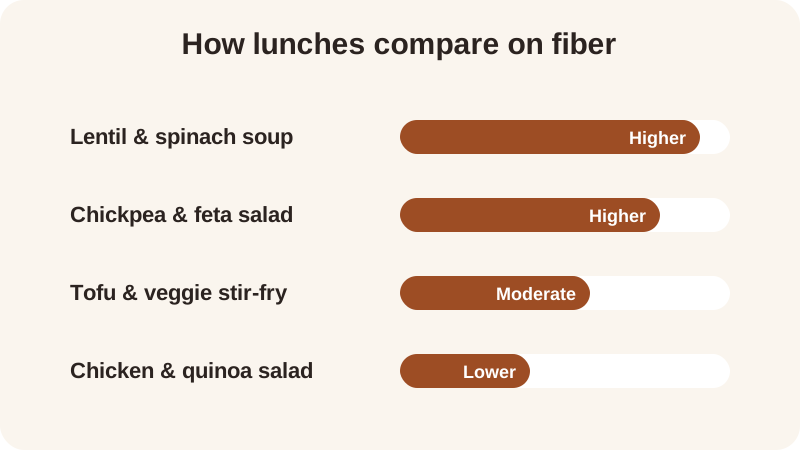
| Lentil & Spinach Soup | 20 g | 14 g | 340 kcal | about 4.1 g | 9.2 |
| Edamame with Sea Salt | 17 g | 8 g | 190 kcal | about 4.2 g | 10.0 |
| Chickpea & Feta Salad | 18 g | 12 g | 420 kcal | about 2.9 g | 8.3 |
| Turkey Chili | 36 g | 13 g | 480 kcal | about 2.7 g | 9.3 |
| Tofu & Vegetable Stir-Fry | 24 g | 9 g | 420 kcal | about 2.1 g | 8.3 |
| Grilled Chicken & Quinoa Salad | 42 g | 8 g | 460 kcal | about 1.7 g | 9.1 |
Edamame edges out the lentil soup on fiber per 100 kcal, but it is a smaller portion overall — a reminder that fiber density and total fiber for the meal are two different things worth looking at together. The full recipe pages, including Lentil & Spinach Soup and Chickpea & Feta Salad, show the full score breakdown for each one.
How do you build a high-fiber lunch from what's in the kitchen?
Start from whatever protein is already planned and add a fiber-dense food next to it rather than swapping anything out. A half cup of cooked lentils adds roughly 8 g of fiber and about 115 kcal; a half cup of canned chickpeas, drained and rinsed, adds roughly 6 g of fiber for about 135 kcal. Stirred into a bowl that already has some protein, either one raises fiber per 100 kcal without changing much else about the meal.
Take a turkey and vegetable bowl built around Turkey Chili as a working example: 36 g protein, 13 g fiber and 480 kcal works out to about 7.5 g protein and 2.7 g fiber per 100 kcal — above both the protein reference (7 g per 100 kcal) and the fiber reference (2 g per 100 kcal), which is part of why it scores 9.3. Swapping in a cup of extra chopped bell pepper or a side of black beans would push the fiber number higher still.
If you want to try your own combination before lunch, the meal score calculator lets you enter protein, fiber, added sugar and calories for any bowl and see where the four parts land.
Does a lunch have to hit the fiber reference every time?
No — the 2 g per 100 kcal figure is a general nutrition reference this score uses to compare meals against each other, not a daily number to reach or a clinical threshold. A lunch that comes in under it, like a quinoa and chicken salad at about 1.7 g per 100 kcal, still scores 9.1 overall because its protein and quality parts are strong.
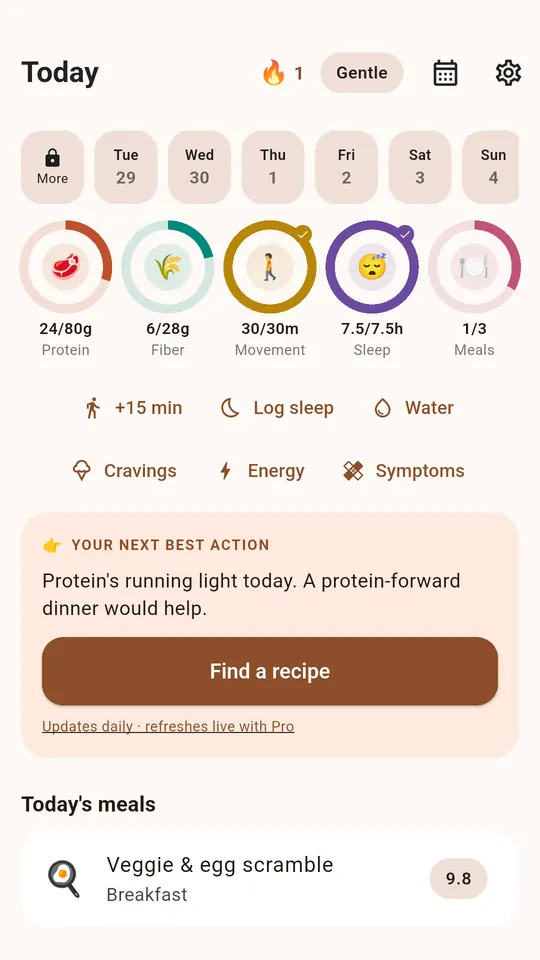
If counting calories and watching a scale is not something you want in your lunch tracking, Gentle Mode shows the meal score, including the fiber part, with no calories and no scale anywhere in the app. For anyone who does want calories, macros and a weight trend alongside the score, Weight Loss Mode shows those next to the same four-part breakdown. Either way, fiber shows up as one of the app's five rings — alongside protein, movement, sleep and meals — and the fiber tracker scores each meal logged through the day.
Nutrition figures pulled from a photo of a lunch are estimates, the same as any portion-based math in this article. For a side-by-side look at fiber alongside protein in smaller meals, the high fiber snacks with protein guide works through the same per-100-calorie approach for snacks rather than full lunches.
Frequently asked questions
What counts as a high fiber lunch?
On the meal score, a high fiber lunch is one with more than about 2 g of fiber per 100 kcal, which is the fiber reference the score uses. Lentil & Spinach Soup works out to about 4.1 g per 100 kcal, well above that reference, while a plain quinoa bowl sits closer to 1 g.
Which lunch recipes on this site score highest for fiber?
Lentil & Spinach Soup (14 g fiber, meal score 9.2) and Chickpea & Feta Salad (12 g fiber, meal score 8.3) are the two highest-fiber lunches among the twelve scored recipes. Both also carry enough protein to score well on that part too.
How do I add fiber to a lunch I already make?
Stir in a half cup of cooked lentils, chickpeas or black beans, or add a cup of leafy greens or chopped vegetables. Each adds grams of fiber without many added calories, which raises fiber per 100 kcal and moves the fiber part of the score up.
Does lunch need to hit the fiber reference every day?
No. The 2 g per 100 kcal figure is a general nutrition reference the meal score uses, not a clinical target or a daily requirement. It is there to compare meals against each other, not to set a number you have to reach.
General nutrition information, not medical advice. Figures are estimates. Talk to a doctor or dietitian about your own needs.