 PCOS Weight Loss
High Protein Grocery List, Scored by the App
A high protein grocery list sorted by protein per 100 calories, paired with fiber sources and a clear note on what stays on your phone versus what a meal photo sends for scoring.
Published · Updated
Quick answer
A high protein grocery list sorts foods by protein per 100 calories against the score's 7 g reference, pairs each pick with a fiber source, and checks added sugar on labels. Meals logged by hand stay on your phone; a meal photo is sent off to identify the food and no copy is kept.
Key takeaways
- Sort a high protein grocery list by protein per 100 calories, not grams per serving.
- Pair each protein pick with a fiber source since fiber counts for 30% of the meal score too.
- Meals, weight, cycle days and symptoms you log are stored on the phone, with no account needed.
- A meal photo is sent to the app's server and on to OpenAI to identify the food, and no copy is kept.
- Logging a meal by hand instead sends nothing off the phone.
A high protein grocery list is simplest to use when you sort foods by protein per 100 calories, not by the grams printed on the front of the package. That single number shows how much a food lifts the protein part of a meal's score, whatever portion you end up buying.
The same list doubles as a high protein foods list for a Tuesday shop or a high protein shopping list kept on your phone, since the numbers behind each food don't change from week to week.
What foods belong on a high protein grocery list?
Eggs, plain poultry, fish, dairy, legumes and tofu are the groups that show up most often on a high protein grocery list, because their protein per 100 calories tends to sit at or near the meal score's reference of 7 g per 100 kcal. That reference is a general nutrition reference the score uses, not a clinical target.
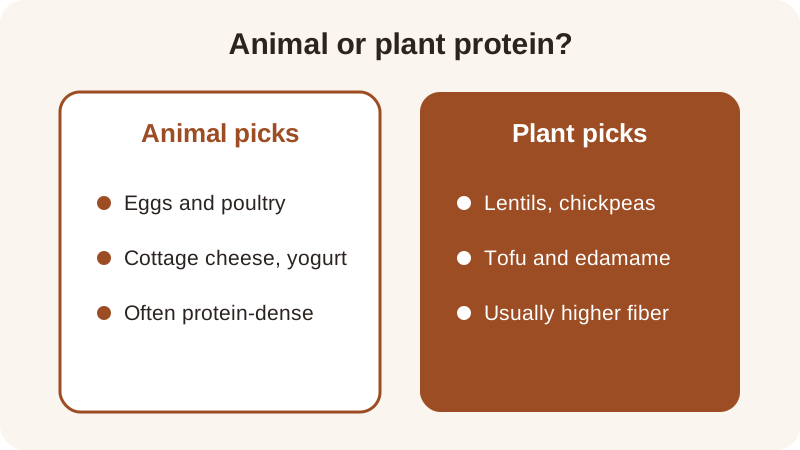
Animal and plant picks both work toward the protein part of a meal's score; the real difference between the two groups usually shows up in fiber, not in which one counts for more. A cup of edamame carries protein and fiber together, part of why Edamame with Sea Salt scores a 10.0 on its recipe page.
| Food, typical portion | Protein per 100 kcal (about) |
|---|---|
| Chicken breast, cooked | 19 g |
| Turkey breast, cooked | 18 g |
| Cottage cheese | 12 g |
| Greek yogurt, plain | 10 g |
| Edamame | 9 g |
| Eggs | 8 g |
| Lentils, cooked | 8 g |
| Tofu, firm | 8 g |
None of these foods is better or worse to buy. The table only shows which ones lift the protein part of a meal's score the most per 100 calories, which is a useful starting point for a grocery list built around protein and fiber together.
Snack-sized protein items belong on the list too, not just dinner proteins. Cottage Cheese & Cucumber Snack pairs about 20 g of protein with about 180 kcal, and Apple with Almond Butter adds fiber from the apple alongside the almond butter's protein, scoring 6.8 largely because its protein density sits well below the reference. Both are already worked out on the meal plan page if you want more combinations without doing the math yourself.
How much protein per 100 calories counts as high?
The meal score measures protein against a flat reference of 7 g per 100 kcal, and foods above that reference pull the protein part of the score higher. Turkey Chili lists about 36 g of protein in 480 kcal: divide 36 by 480 and multiply by 100 and you get about 7.5 g per 100 kcal, just over the reference, part of why it scores 9.3 out of 10.
Lentil & Spinach Soup works out to about 5.9 g per 100 kcal (20 g protein in 340 kcal), below the protein reference on its own, yet it still scores 9.2 because its 14 g of fiber carries the fiber part of the score. A grocery list built only around protein misses that half of the picture — the four parts are combined unrounded before the final number is rounded for display. See the full math on how the score works.
How do you keep fiber and added sugar in mind while shopping?
Pair the protein items on your list with beans, lentils, vegetables, fruit and whole grains, since the meal score weighs fiber as much as protein — 30% each — against its own reference of 2 g of fiber per 100 kcal. A fiber tracker run on foods you already buy is one way to see where fiber is thin.
Added sugar is worth a glance on the label too: the score checks it against a flat 12 g reference, and lower added sugar scores higher. Flavored yogurts, sauces and some protein bars carry more added sugar than a plain version of the same food, so reading the added sugar line before sodium or calories is a quick way to shop.
How do you build the list so it covers all four parts of the score?
A high protein grocery list works best when it's really a list for all four parts of the meal score at once: protein, fiber, added sugar and quality. A short, repeatable process is easier to shop with than trying to remember every reference number in the aisle.
- Pick two or three protein items from the table above — one animal source and one plant source covers more ground.
- Add a fiber source for each protein item: beans, lentils, a vegetable or a piece of fruit.
- Check the added sugar line on anything packaged, especially yogurt, sauces and bars.
- Favor the plainest version of a food when two options sit side by side, since minimally processed foods count more toward the quality part of the score than ultra-processed ones.
That last step is the quality part of the score in practice: minimally processed food counts 1.0, processed food counts 0.6 and ultra-processed food counts 0.15, by calories. More on what counts as which is on the ultra-processed food guide.
How does a grocery list fit with the meal score and the app?
Once the list is in the kitchen, the PCOS Weight Loss app can turn a plate into a score from a photo, scoring protein, fiber, added sugar and quality each time. Gentle Mode shows that score with no calories and no scale anywhere, while Weight Loss Mode adds calories, macros and a weight trend next to it, so the same grocery list works for either way of tracking.
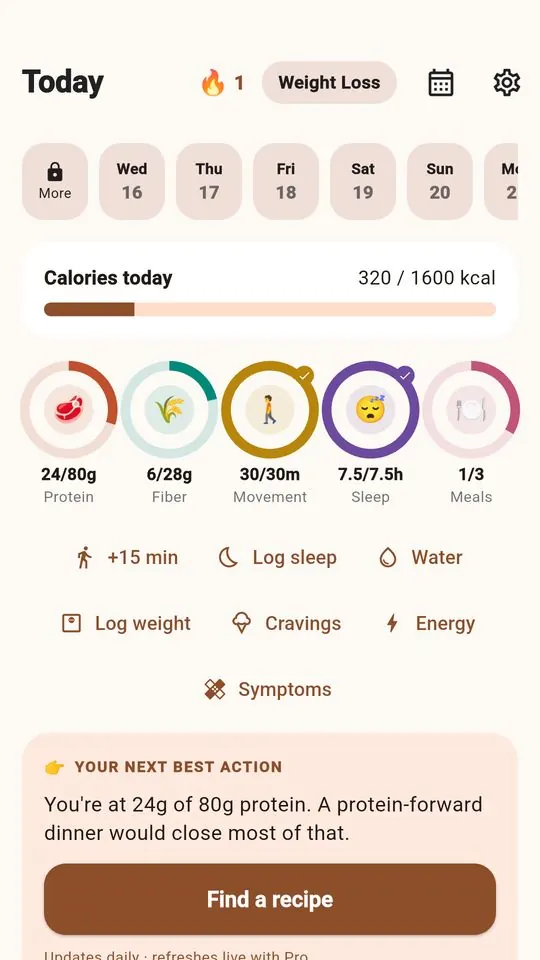
The five rings in the app — protein, fiber, movement, sleep and meals — sit alongside the score, so you can see which ring a grocery swap affected. The app is free to start. Before buying a specific brand, you can test a combination in the meal score calculator.
Frequently asked questions
Does the app store my grocery list or meals?
Meals, weight, cycle days and symptoms you log are stored on the phone, and the app needs no account. A meal photo is the exception: it's sent to the app's server and on to OpenAI to identify the food, then no copy is kept. Logging a meal by hand instead sends nothing off the phone.
What foods belong on a high protein grocery list?
Eggs, plain poultry, fish, dairy, legumes and tofu show up most often, since their protein per 100 calories sits at or near the meal score's reference of 7 g per 100 kcal. Pairing each one with a fiber source, like a vegetable or beans, covers more of the four-part score.
Is animal or plant protein better for a high protein grocery list?
Neither counts for more in the protein part of the score. Animal picks like poultry and cottage cheese tend to sit higher in protein per 100 calories, while plant picks like lentils, chickpeas and tofu often add more fiber alongside their protein.
How much protein per 100 calories counts as high?
The meal score compares protein against a flat reference of 7 g per 100 kcal. Foods above that, like cottage cheese at about 12 g or edamame at about 9 g per 100 kcal, pull the protein part of a meal's score higher; foods below it still score well if fiber is high.
Does buying high protein foods guarantee a high meal score?
No. The score also weighs fiber, added sugar and how processed a food is, each combined unrounded before the final number is rounded. A protein bar high in added sugar can score lower than a simple food like plain yogurt or lentils with less protein per serving.
General nutrition information, not medical advice. Figures are estimates. Talk to a doctor or dietitian about your own needs.