 PCOS Weight Loss
How Many Grams of Fiber in a Meal?
The article explains the meal score's fiber reference of about 2 g per 100 kcal, works through examples of how much fiber that means for meals of different sizes, and shows swaps that raise fiber without recalculating the whole plate.
Published
Quick answer
How many grams of fiber in a meal depends on its size: the meal score's reference is about 2 g of fiber per 100 kcal, so a 400 kcal meal near that reference has about 8 g, and a 600 kcal meal has about 12 g.
Key takeaways
- The fiber reference the meal score uses is about 2 g of fiber per 100 kcal, not a clinical target
- A 400 kcal meal near that reference has about 8 g of fiber; a 600 kcal meal has about 12 g
- Fiber is 30% of the 0–10 meal score, the same weight as protein
- Site recipes range from about 2.6 g to 4.2 g of fiber per 100 kcal
- Adding beans, lentils, chia or vegetables to a plate raises its fiber total without changing much else
How many grams of fiber in a meal makes a difference? The meal score's fiber reference is about 2 g of fiber per 100 kcal, so the number that counts as a lot scales with how many calories the meal has.
A small snack and a full dinner can't use the same flat gram target, which is why the fiber part of the score works in per-100-kcal terms instead of one number for every meal regardless of size. That's also why two meals with the same total fiber grams can land on very different parts of the score, once their calories are taken into account.
How many grams of fiber counts as a lot in one meal?
Using the reference of about 2 g of fiber per 100 kcal, a 300 kcal breakfast near that reference has about 6 g of fiber, a 450 kcal lunch has about 9 g, and a 600 kcal dinner has about 12 g. These are the reference figures this score uses, not a clinical target — a meal with less fiber than that simply scores lower on the fiber part, not wrong.
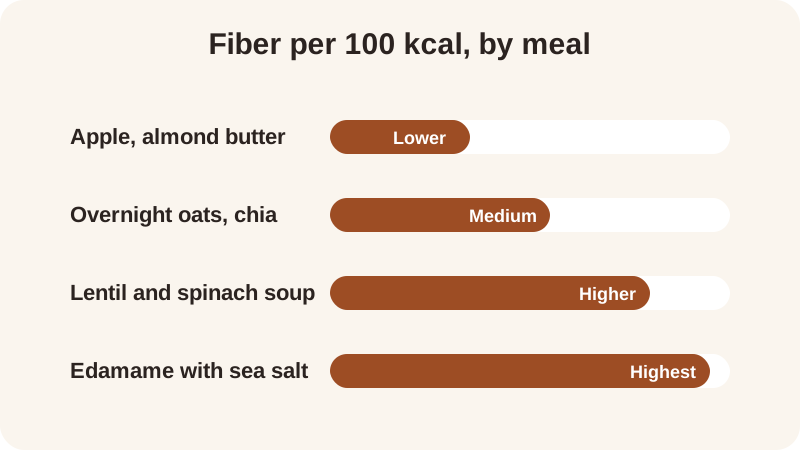
Among the site's twelve recipes, fiber density ranges from lower examples like Apple with Almond Butter, with about 6 g of fiber in 220 kcal, to higher ones like Edamame with Sea Salt, with 8 g of fiber in 190 kcal — roughly 2.7 g and 4.2 g per 100 kcal. Both are complete recipes; the difference is how fiber-dense each one is for its calories, not which is better to eat.
How do you add up fiber grams across a whole meal?
Add the fiber listed for each food on the plate, then divide the total by the meal's total calories and multiply by 100. A bowl of Lentil & Spinach Soup with about 14 g of fiber and about 340 kcal works out to roughly 4.1 g of fiber per 100 kcal, well above the 2 g reference, while Turkey Chili, with about 13 g of fiber in 480 kcal, comes to about 2.7 g per 100 kcal.
| Meal (from the site's recipes) | Fiber per 100 kcal (about) |
|---|---|
| Edamame with Sea Salt | 4.2 g |
| Lentil & Spinach Soup | 4.1 g |
| Chickpea & Feta Salad | 2.9 g |
| Turkey Chili | 2.7 g |
| Apple with Almond Butter | 2.7 g |
| Overnight Oats with Chia | 2.6 g |
None of these is better or worse to eat — the table only shows how much each one moves the fiber part of a meal's score once it's part of what's logged. Try totaling your own plate in the meal score calculator to see where it lands, or compare a few plates side by side before settling on what to log for the day.
What does the fiber part do to a meal's score?
Fiber makes up 30% of the 0–10 meal score, the same weight as protein, while added sugar is 20% and quality — how processed the food is — is another 20%. The four parts are combined unrounded, and only the final score shown is rounded, so a meal that falls short of the fiber reference still earns a partial fiber score rather than none at all.
A meal like Turkey Chili, with 36 g of protein and 13 g of fiber in 480 kcal, scores 9.3 once all four parts are counted together — fiber is one piece of that number, not the whole thing. The exact reference figures for protein, fiber, added sugar and quality are laid out on the how the score works page. A meal can also score well on fiber and still land lower overall if its added sugar or quality parts pull the combined number down, which is part of why the score looks at all four pieces together rather than fiber alone.
How can you raise a meal's fiber without changing much else?
Adding a fiber-dense food to a plate tends to move the fiber part of the score without changing protein much. Stirring chia or oats into a bowl, adding beans or lentils to a grain dish, or including more vegetables alongside a protein source are common ways to raise the fiber total for a similar calorie cost.
- Add chickpeas to a salad for extra fiber per 100 kcal, as in Chickpea & Feta Salad, which carries about 12 g of fiber in 420 kcal.
- Stir chia seeds into oats or yogurt, as in Overnight Oats with Chia, with about 10 g of fiber in 380 kcal.
- Add vegetables to a stir-fry, soup or scramble rather than scaling up the protein portion alone.
For more worked breakfast and lunch examples, see how to add fiber to breakfast and high fiber lunch ideas, scored. Logging a plate with the fiber tracker or a photo in the app gives an estimate for the meal in front of you, rather than a flat number meant for every meal of that size. Over a few meals, that estimate can show which plates tend to sit above the reference and which ones tend to sit below it, without needing to recalculate by hand each time.
Frequently asked questions
How many grams of fiber should one meal have?
There's no fixed number for every meal — the meal score's reference is about 2 g of fiber per 100 kcal, so it scales with meal size. A 300 kcal breakfast near that reference has about 6 g of fiber; a 600 kcal dinner has about 12 g. It's a reference this score uses, not a clinical target.
Does a small snack need the same fiber grams as a big dinner?
No. Because the reference is per 100 kcal, a smaller snack naturally needs fewer grams to hit the same density as a larger meal. A 190 kcal snack near the reference has about 4 g of fiber, while a 480 kcal meal near it has closer to 10 g.
What foods add the most fiber to a meal?
Legumes, chia and vegetables tend to add fiber without many calories. Lentil & Spinach Soup carries about 14 g of fiber in 340 kcal, and Edamame with Sea Salt carries about 8 g in 190 kcal — both land well above the 2 g per 100 kcal reference.
Do you need a kitchen scale to count fiber in a meal?
No. A photo in the app gives an estimate of the fiber, protein, added sugar and quality in a meal, and those figures are always estimates rather than exact measurements. Gentle Mode shows that same estimate with no calories or scale anywhere in the screen.
Is a meal with lots of fiber automatically a high score?
Not on its own. Fiber is 30% of the 0–10 meal score, and protein, added sugar and quality (how processed the food is) each contribute their own share, combined unrounded before the final number is rounded for display.
General nutrition information, not medical advice. Figures are estimates. Talk to a doctor or dietitian about your own needs.