 PCOS Weight Loss
How to Compare Cereal Labels for Fiber
A guide to comparing cereal labels for fiber by working out grams of fiber per 100 calories instead of relying on the serving size printed on the box.
Published
Quick answer
To compare cereal labels for fiber, divide the fiber grams by the calories per serving and multiply by 100. That per-100-calorie figure stays fair across boxes with very different serving sizes.
Key takeaways
- Compare fiber grams divided by calories, not fiber grams per serving alone
- Bran and shredded-wheat types usually run about 3 to 5 g fiber per 100 kcal
- The meal score's fiber reference is 2 g of fiber per 100 kcal, not a target
- Check the added sugar line and first ingredient alongside the fiber number
- Milk, fruit or nuts change the whole bowl's per-100-kcal numbers
Here's how to compare cereal labels for fiber: divide the fiber grams per serving by the calories per serving, then multiply by 100. A cereal with about 3 g of fiber and about 150 kcal per serving works out to roughly 2 g of fiber per 100 kcal, and that per-100-kcal figure is what actually compares fairly across different boxes.
Why doesn't the serving size on the box help you compare?

Cereal boxes list wildly different serving sizes — some call out 30 g, some 40 g, some a full cup — so two boxes that both say "5 g of fiber per serving" can be far apart once you look at the calories sitting behind that number. Comparing fiber grams per serving really means comparing scoop sizes, not the cereal itself.
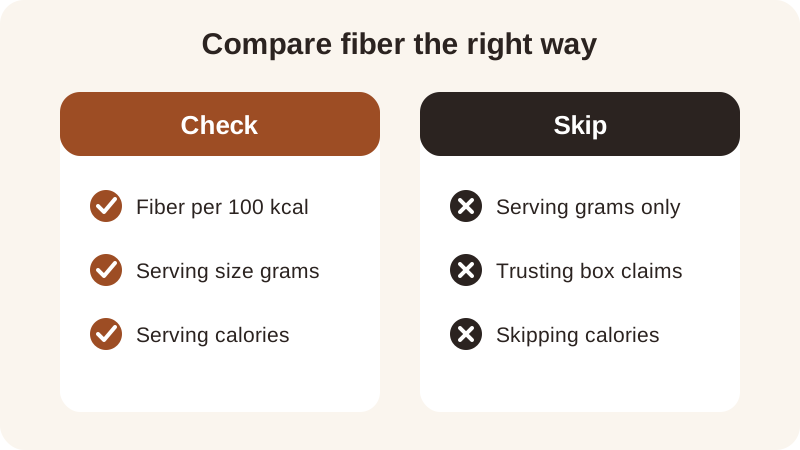
The fix is to normalize: divide the label's fiber grams by its calories, multiply by 100, and you get a figure that holds steady no matter how big the serving is. That's the same approach the meal score uses for its fiber part, measured against a reference of 2 g of fiber per 100 kcal — a general reference the score uses, not a clinical target.
How do you work out fiber per 100 calories from a label?
The nutrition panel already has everything you need: fiber grams, calories, and the serving size they both refer to. Run the same steps on every box you're holding and the numbers line up side by side.
- Find the "dietary fiber" line and the calories, both for the same serving size.
- Divide the fiber grams by the calories.
- Multiply that result by 100 to get grams of fiber per 100 kcal.
- Repeat for each box and compare the per-100-kcal figures directly.
As a worked example, a wheat-biscuit type cereal might list about 3 g of fiber and about 150 kcal for a two-biscuit serving: 3 ÷ 150 × 100 comes out to about 2 g of fiber per 100 kcal. A bran-flake type cereal might list about 5 g of fiber and about 110 kcal for a 30 g serving: 5 ÷ 110 × 100 comes out to about 4.5 g of fiber per 100 kcal — more than double, even though the raw "5 g" only looks a little bigger than "3 g." A granola with about 4 g of fiber but about 220 kcal for a half-cup serving works out to under 2 g per 100 kcal, which shows why the calorie side of the label matters just as much as the fiber side.
Which types of cereal tend to score higher for fiber?
Bran-based and shredded-wheat type cereals are usually the most fiber-dense per 100 kcal, with flaked corn or rice cereals usually the least. Granola and muesli sit in between and vary a lot from one box to the next, since added nuts, oats and dried fruit each change the calorie count differently.
| Cereal type, typical serving | Fiber per 100 kcal (about) |
|---|---|
| Bran flake type | 4 to 5 g |
| Shredded wheat type | 3 to 4 g |
| Muesli | 2 to 3 g |
| Granola | 1.5 to 2.5 g |
| Corn flake or rice type | 0.5 to 1 g |
These are typical ranges, not a rule — two boxes in the same row can still land in different spots depending on how much bran or whole grain they actually contain. Running the math on the label in front of you still matters more than the category name. For a sense of how a cereal's fiber number sits alongside a full meal's fiber, the fiber per meal guide works through that from the other direction.
What else on the label changes how a bowl of cereal scores?
Fiber is only one part of a meal's score. The added sugar line matters just as much — two cereals with the same fiber-per-100-kcal figure can score very differently once you see whether one is carrying about 2 g and the other about 12 g of added sugar per serving. The added sugar label guide walks through where that line sits on the panel and the names it can hide under in the ingredient list.
How processed the cereal is counts too. In the quality part of the score, minimally processed food counts 1.0, processed counts 0.6 and ultra-processed counts 0.15, by calories — a muesli made mostly of whole oats, nuts and dried fruit sits toward the minimally processed end, while a puffed, coated or heavily flavored cereal sits further toward ultra-processed. Protein, fiber, added sugar and quality are weighed at 30%, 30%, 20% and 20% of the score and combined unrounded before only the final number is rounded for display.
Milk, yogurt or fruit stirred into the bowl change the whole-bowl math, not just the cereal's own numbers. Milk adds protein and calories but close to no fiber, so recalculate using the combined fiber grams and combined calories of cereal plus milk rather than the cereal figure alone. Adding sliced fruit raises the fiber grams a little while adding few calories, which usually nudges the per-100-kcal figure up. The guide to adding fiber at breakfast has more combinations, and the overnight oats with chia recipe shows what a whole-grain, higher-fiber breakfast looks like scored out. You can run your own bowl, milk and toppings included, through the meal score calculator, or let the fiber tracker total it from a photo instead of doing the arithmetic by hand.
Frequently asked questions
What's a reasonable amount of fiber per 100 calories for cereal?
There's no fixed cutoff, but the meal score in PCOS Weight Loss uses 2 g of fiber per 100 kcal as its general reference, not a clinical target. Bran and shredded-wheat type cereals often land above that; flaked corn or rice types often land below it.
Why do two cereals with '5 g fiber per serving' seem so different?
Their serving sizes and calories likely differ. A 30 g, 110 kcal serving and a 55 g, 200 kcal serving can both say 5 g of fiber, but the first works out to roughly double the fiber per 100 kcal of the second.
Does adding milk change the fiber comparison?
Milk adds calories and protein but essentially no fiber, so it lowers the fiber-per-100-kcal figure for the bowl as a whole. Recalculate using the combined fiber grams and combined calories of cereal plus milk rather than the cereal number alone.
Is granola usually higher in fiber than flaked cereal?
Often yes, but it varies a lot by brand because nuts, oats and dried fruit each add calories differently. Running the fiber-per-100-kcal math on the specific box in front of you is more reliable than assuming by category.
General nutrition information, not medical advice. Figures are estimates. Talk to a doctor or dietitian about your own needs.