 PCOS Weight Loss
Tofu Protein Per Serving: The Numbers
A breakdown of tofu protein per serving by firmness, with per-100-kcal math and a worked meal score example.
Published
Quick answer
Tofu protein per serving is about 8 to 10 grams per 100 grams (3.5 oz), depending on firmness. Extra-firm and firm tofu run slightly denser than soft or silken, and the numbers below work into the app's meal score.
Key takeaways
- Firm and extra-firm tofu run about 8-10 g protein per 100 g, roughly 10-11 g per 100 kcal
- Silken and soft tofu are lower in protein density, about 5-6 g protein per 100 g
- The score's protein reference is 7 g per 100 kcal, a general reference, not a target
- A tofu stir-fry can score well even with protein below reference, since fiber and quality count too
- Pairing tofu with edamame, lentils, or an egg raises the protein density of the whole plate
Tofu protein per serving is about 8 g for a 100 g (3.5 oz) piece of firm tofu, with extra-firm running a little higher and silken or soft running a little lower. That works out to roughly 10 to 11 g of protein per 100 kcal for the firmer types, which is the number the meal score actually uses.
Protein per 100 calories matters more than protein per serving alone, because serving sizes vary from a few cubes in a stir-fry to half a block in a scramble. The numbers below hold whether you're logging a photo in the app or typing a recipe in by hand.
How much protein is in a serving of tofu?
A 100 g (about 3.5 oz) serving — roughly a fifth of a standard block — of firm tofu has about 8 g of protein and about 70 kcal. Extra-firm tofu, which holds less water per gram, runs closer to 10 g of protein and about 90 kcal for the same weight.
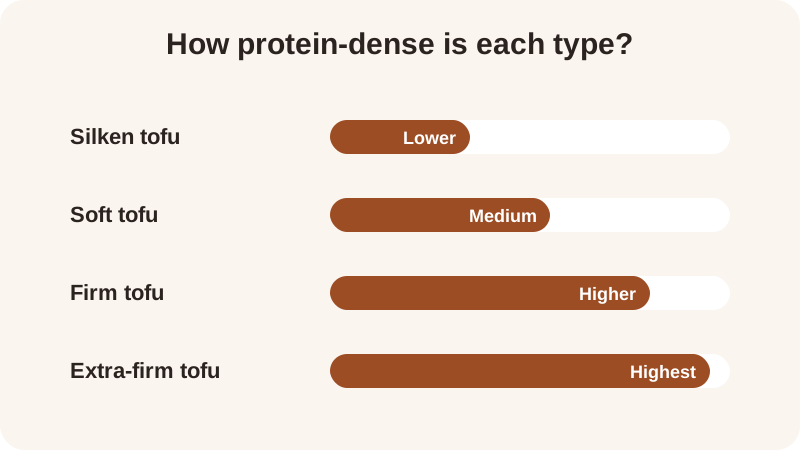
Silken tofu, often used in blended or soft dishes, has about 5 g of protein and about 55 kcal per 100 g, and soft tofu sits between silken and firm. None of these is a better choice than another — the numbers just show how much protein per 100 kcal each type contributes to a dish.
| Food, typical portion | Protein per 100 kcal (about) |
|---|---|
| Extra-firm tofu, 100 g | 11 g |
| Firm tofu, 100 g | 10 g |
| Soft tofu, 100 g | 9 g |
| Silken tofu, 100 g | 8 g |
Does pressing tofu change its protein per serving?
Pressing tofu squeezes out water, not protein, so the grams of protein in a block stay about the same while its weight drops. If a 100 g piece of firm tofu with about 8 g of protein loses some of its water under a press and ends up weighing 85 g, that same 8 g of protein is now packed into a smaller, lighter piece, so the protein per 100 g rises even though the total grams of protein in the piece did not change.
This is also why extra-firm tofu — which starts out with less water than firm tofu — naturally reads a little higher in protein per serving on the label, without being a different soybean product underneath. Freezing and thawing tofu before cooking changes its texture, but it does not meaningfully change the protein numbers on the package, since the protein content was set when the tofu was made, not when it is pressed, frozen or cooked at home.
How does tofu's protein density compare to other foods?
Compared with the reference the meal score uses — 7 g of protein per 100 kcal — plain firm or extra-firm tofu already sits above it, in a similar range to lentils or eggs and a bit below chicken breast. The gap between silken vs firm tofu protein comes down mostly to water content, not to anything added or removed.
Edamame, for comparison, has about 17 g of protein and about 190 kcal per serving in the Edamame with Sea Salt recipe, which works out to about 9 g of protein per 100 kcal — in the same range as firm tofu. You can see the same per-100-kcal approach applied to other foods in this guide to protein per 100 calories, and to whole portions in what 30 g of protein looks like.
How does tofu score in a full meal?
The Tofu & Vegetable Stir-Fry recipe on the site has about 24 g of protein, 9 g of fiber and 420 kcal, and scores 8.3 out of 10. Per 100 kcal, that's about 5.7 g of protein (24 ÷ 420 × 100) and about 2.1 g of fiber (9 ÷ 420 × 100) — protein below the 7 g reference, fiber above the 2 g reference.
The score still lands at 8.3 because fiber, added sugar and quality all factor in too. Protein and fiber are each 30% of the total, added sugar is 20% and quality — how processed the food is — is 20%, and the four parts are combined unrounded before the final score is rounded for display. See the full breakdown on how the meal score works.
What's one way to add more protein to a tofu meal?
Pairing tofu with another protein-dense food raises the protein per 100 kcal of the whole plate without changing the portion of tofu itself. A few spoons of edamame, a boiled egg on the side, or swapping some of the rice for lentils in a dish like the Lentil & Spinach Soup all push the protein part of the score up while fiber and quality stay about where they were.
You can test this with your own plate in the meal score calculator — enter the tofu, the sides, and whatever you add, and see how the protein, fiber, added sugar and quality parts move. Logging it by hand or from a photo works the same way, whether you're using Weight Loss Mode, which shows calories and macros next to the score, or Gentle Mode, which has no calories and no scale anywhere.
Either way, the figures you get from a meal photo are estimates, and the portion shown on the score screen is editable, so you can adjust it before deciding how much tofu or how many sides to count toward the total. Over a week of meals, these small per-100-kcal differences are what shift a plate's protein part from below reference to above it, more than any single serving on its own.
Frequently asked questions
How much protein is in a serving of tofu?
A typical 100 g (about 3.5 oz) serving of firm tofu has about 8 g of protein and about 70 kcal, which works out to roughly 11 g of protein per 100 kcal. Extra-firm tofu runs a little higher, silken and soft tofu a little lower, because they hold more water per gram.
Is firm or silken tofu higher in protein?
Firm and extra-firm tofu are denser in protein than silken or soft tofu, because they have less water per gram. A 100 g serving of extra-firm tofu runs about 10 g protein, while the same weight of silken tofu runs closer to 5 g, simply from the water content difference.
Does tofu meet the meal score's protein reference?
The meal score's protein reference is 7 g of protein per 100 kcal, a general nutrition reference rather than a clinical target. Plain firm or extra-firm tofu, at about 10-11 g per 100 kcal, sits above that reference on its own, before anything else is added to the dish.
How can I raise the protein in a tofu meal?
Pairing tofu with another protein-dense food — edamame, lentils, or a boiled egg on the side — raises the protein per 100 kcal of the whole plate. You can test any combination in the meal score calculator to see how it shifts the protein part of the score.
Does pressing tofu change its protein per serving?
Pressing removes water, not protein, so the grams of protein in the block stay about the same while the weight drops. That makes pressed tofu slightly denser in protein per 100 g and per 100 kcal than the same block straight from the package.
General nutrition information, not medical advice. Figures are estimates. Talk to a doctor or dietitian about your own needs.