 PCOS Weight Loss
What Does 30 Grams of Protein Look Like?
Ordinary portions like a chicken breast, five eggs, or a pot of Greek yogurt each supply about 30 grams of protein, though their calories and effect on a meal's score differ widely.
Published · Updated
Quick answer
What does 30 grams of protein look like? It's about a 100 g cooked chicken breast, five eggs, a large pot of Greek yogurt, or one and a half cups of cooked lentils — different portions, very different calories and fiber.
Key takeaways
- About 30 g of protein: one chicken breast, five eggs, a large yogurt pot, or 1.5 cups of cooked lentils.
- The same 30 g of protein scores differently per 100 kcal depending on the rest of the plate.
- Gentle Mode scores a meal from a photo with no calories or scale shown.
- Meals, weight, cycle days and symptoms you log are stored on the phone.
- A meal photo goes to the app's server and OpenAI to identify food; no copy is kept. Typing it in sends nothing off the phone.
What does 30 grams of protein look like? It's about a 100 g cooked chicken breast, five eggs, or a large pot of plain Greek yogurt — ordinary portions that happen to land near the same protein number, even though their calories and fiber differ a lot.
None of these portions is "the" right one. They're just different routes to the same gram count, with very different calories attached, which is what actually shifts a meal's score.
How much food gives you about 30 grams of protein?
A typical 100 g cooked chicken breast has about 30 g of protein and around 165 kcal. A large pot of plain Greek yogurt (roughly 300 g) lands close to the same protein with somewhat fewer calories, while eggs get there at about five and plant foods need a bigger portion — around one and a half cups of cooked lentils, or a larger serving of tofu or edamame.
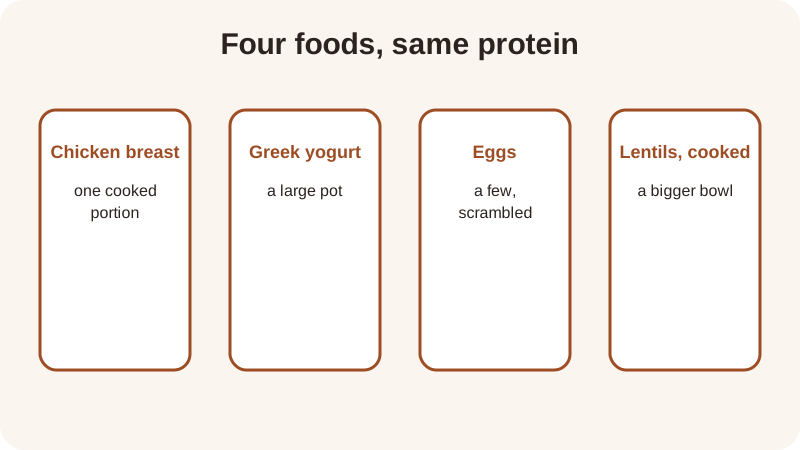
These are estimates built from ordinary, typical values — one egg, one chicken breast, or one cup of lentils can sit a little above or below these numbers. A cup and a half of cottage cheese gets close as well, since cottage cheese tends to run fairly protein-dense for its calories. For a longer list of foods and their protein density, see the high protein grocery list.
Does the size of the portion matter, or just the protein grams?
Both matter, because the meal score doesn't look at protein grams on their own — it looks at protein per 100 kcal, compared against a reference of 7 g per 100 kcal. That reference is a general nutrition reference the score uses, not a clinical target, and it applies the same way regardless of how the protein is packaged.
So 30 g of protein from a 165 kcal chicken breast works out to about 18 g per 100 kcal, well above the reference. The same 30 g spread across a 500 kcal plate — a protein portion plus a starch, a sauce and a larger side — comes to about 6 g per 100 kcal, below the reference, even though the protein count in both cases is identical. The arithmetic is covered in more detail on the protein per 100 calories guide.
| Food, typical portion | Protein (about) | Protein per 100 kcal (about) |
|---|---|---|
| Chicken breast, cooked, 100 g | 30 g | 18 g |
| Greek yogurt, plain, large pot | 30 g | 17 g |
| Eggs, about five | 30 g | 8.5 g |
| Lentils, cooked, about 1.5 cups | 30 g | 9 g |
| Tofu, firm, larger portion | 30 g | 8 g |
None of these foods is better than another for hitting 30 g — the table only shows how much that 30 g "costs" in calories, which is what moves the protein part of a score up or down.
What does 30 grams of protein do to a meal's score?
It's one part of four. The meal score runs 0–10 and combines protein, fiber, added sugar and quality — how processed the food is — with protein and fiber each worth 30% of the total, added sugar 20% and quality 20%. The parts are combined unrounded, and only the final number is rounded for display.
Look at a few of the twelve recipes on the site. A Veggie & Egg Scramble has about 26 g of protein across 340 kcal — roughly 7.6 g per 100 kcal, just over the reference — and scores 9.0 overall. A bowl of Turkey Chili has about 36 g of protein across 480 kcal, about 7.5 g per 100 kcal, and scores 9.3. Both land near the protein reference even though neither is exactly 30 g, because fiber, added sugar and quality move the final number too.
Compare that with the Grilled Chicken & Quinoa Salad: about 42 g of protein and 460 kcal, close to 9.1 g per 100 kcal — well above the reference — and it scores 9.1 overall, helped by a solid protein number but held slightly down by having less fiber than some of the other recipes. You can try your own numbers in the meal score calculator, or read the full breakdown on how the score works.
What if you don't want to count grams at all?
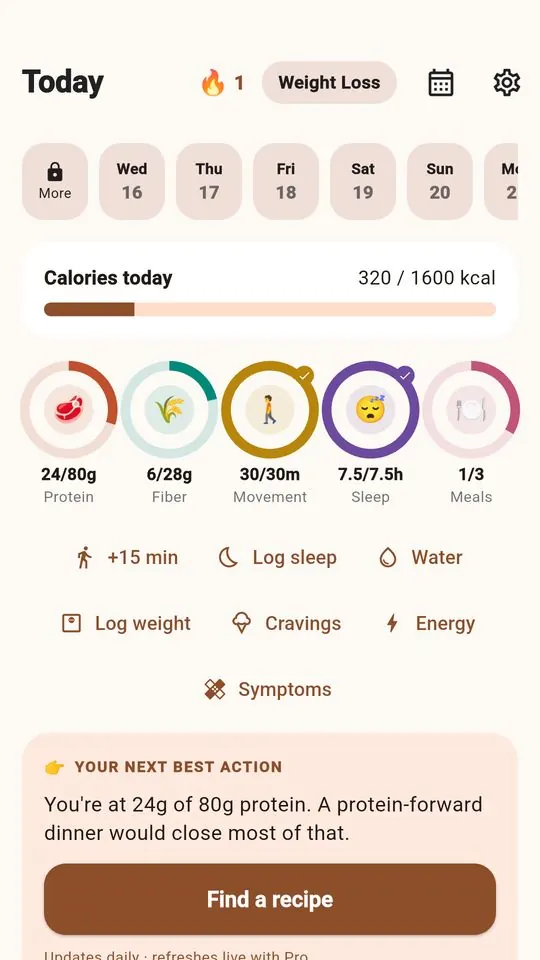
You don't have to. Gentle Mode in the PCOS Weight Loss app has no calories and no scale anywhere — it still scores a meal's protein, fiber, added sugar and quality from a photo, using the five rings for protein, fiber, movement, sleep and meals, without ever showing a gram count or a calorie total. If you do want the numbers alongside the score, Weight Loss Mode shows calories, macros and a weight trend next to the same 0–10 score.
Meals, weight, cycle days and symptoms you log are stored on the phone, and there is no account needed to start. A meal photo works differently: it's sent to the app's server and on to OpenAI to identify the food, and no copy is kept afterward. Logging a meal by hand — typing in the chicken breast, the eggs, or the yogurt — sends nothing off the phone at all. For a side-by-side look at the two tracking approaches, see track food without counting calories or the PCOS app without calorie counting guide.
A quick way to picture 30 grams without weighing anything
A palm-sized piece of cooked chicken, fish or tofu is a reasonable stand-in for about 20 to 30 g of protein, depending on thickness. A large pot of plain yogurt, or about a cup and a half of cottage cheese, lands in a similar range. A combination plate — eggs plus beans, or chicken plus lentils — gets there with smaller portions of each, which is often the easier route when neither food alone feels like the right size.
Frequently asked questions
What does 30 grams of protein look like in everyday food?
About 30 g of protein is a 100 g cooked chicken breast and roughly 165 kcal, a large pot of plain Greek yogurt, about five eggs, one and a half cups of cooked lentils, or a larger portion of tofu or edamame. Each is an ordinary portion that lands near the same protein count, though calories and fiber differ a lot.
Does 30 grams of protein always score well?
No. The meal score compares protein against calories — the reference is 7 g of protein per 100 kcal, a general nutrition reference, not a clinical target. The same 30 g scores higher from a 165 kcal chicken breast than from a 500 kcal plate, because the protein-per-100-kcal number drops as calories rise.
Do I need to weigh food to get 30 grams of protein?
No. A palm-sized piece of cooked chicken, fish or tofu is a reasonable stand-in for about 20 to 30 g of protein, and a large pot of yogurt or a cup and a half of cottage cheese lands in a similar range without a scale.
What happens to my data when I log a meal?
Meals, weight, cycle days and symptoms you log are stored on the phone, and there is no account. A meal photo is sent to the app's server and on to OpenAI to identify the food, and no copy is kept; logging a meal by hand sends nothing off the phone.
Can I track protein without counting calories?
Yes. Gentle Mode scores a meal's protein, fiber, added sugar and quality from a photo with no calories and no scale anywhere in the app. Weight Loss Mode shows calories, macros and a weight trend next to the same score, if you want those numbers too.
General nutrition information, not medical advice. Figures are estimates. Talk to a doctor or dietitian about your own needs.