 PCOS Weight Loss
How to Add Fiber to Breakfast
A practical look at how to add fiber to breakfast using fiber-per-100-calorie add-ins like chia, berries and oats, plus how that moves the meal score's fiber part.
Published · Updated
Quick answer
The quickest way to add fiber to breakfast is a small add-in — a tablespoon of chia seeds, a half cup of berries, or a scoop of beans — on top of what's already there, since fiber per 100 kcal moves more from an add-in than from swapping the whole plate.
Key takeaways
- Fiber per 100 kcal matters more than fiber per bowl for the score — small add-ins move it more than big bowls
- Chia seeds and berries can take a breakfast from about 0.4 g fiber per 100 kcal to close to 3 g
- The meal score's fiber reference is 2 g fiber per 100 kcal — a general reference, not a target
- Logging a meal by hand sends nothing off the phone; a meal photo goes to the app's server and OpenAI, with no copy kept
- Meals, weight, cycle days and symptoms you log are stored on the phone, and the app needs no account
Here's how to add fiber to breakfast without rebuilding the whole plate: swap in or add a food with more fiber per 100 calories — chia seeds, berries, oats or beans — on top of what's already there. A plain bagel with cream cheese runs about 2 g of fiber for roughly 350 kcal, while oats with chia and berries can carry 8 to 10 g of fiber for a similar calorie count.
What foods add the most fiber to breakfast?
Some breakfast staples carry very little fiber no matter how big the bowl, while others add several grams for not many calories. This list is ordered by fiber per 100 kcal, not by serving size, which is also how the meal score looks at it.
| Breakfast food, typical portion | Fiber per 100 kcal (about) |
|---|---|
| Raspberries, 1 cup | 12 g |
| Chia seeds, 1 tbsp | 7 g |
| Apple with Almond Butter (recipe) | 2.7 g |
| Overnight Oats with Chia (recipe) | 2.6 g |
| Rolled oats, dry, 1/2 cup | 2.6 g |
| White bagel | 0.6 g |
This isn't a ranking of better or worse foods — it only shows how far each one moves the fiber part of a meal's score once it's added to a bowl that's already there.
How much fiber should a breakfast add to the score?
The meal score weighs fiber as 30% of the total, alongside protein at 30%, added sugar at 20% and quality at 20%, and it compares a meal's grams of fiber per 100 kcal with a reference of 2 g per 100 kcal. That reference is a general nutrition reference the score uses, not a clinical target, as explained on the how the score works page.
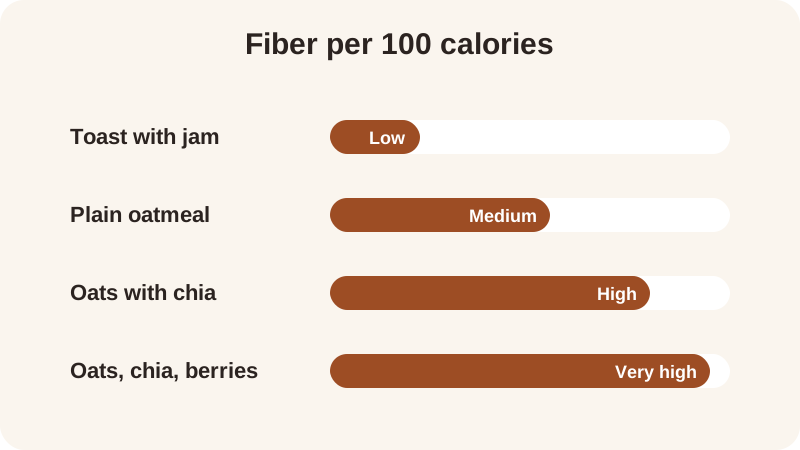
Take a breakfast of two scrambled eggs and a slice of white toast: about 14 g protein, 1 g fiber, 280 kcal. That works out to roughly 0.4 g of fiber per 100 kcal, well under the 2 g reference, so the fiber part of the score sits low even though protein is solid. Swap the toast for a half cup of cooked oats stirred with a tablespoon of chia seeds and a half cup of raspberries, and the same meal picks up about 9 g of fiber for a similar 300 kcal — close to 3 g of fiber per 100 kcal, which clears the reference.
The four parts of the score are combined unrounded before the final number is rounded for display, so even a partial lift in fiber changes the total a little, not just the fiber column. Try your own numbers in the meal score calculator. If you want to see the fiber part of the score without seeing a calorie number at all, Gentle Mode shows the same four-part score with no scale and no calories anywhere in the app.
What's an easy way to add fiber without changing the whole meal?
Most breakfasts don't need a rebuild — a small addition on top of what's already there usually moves the fiber part of the score more than swapping the whole plate does.
- Start with what's already on the plate — eggs, yogurt, toast — and note its rough calories.
- Add one fiber-dense food: a tablespoon of chia seeds, a half cup of raspberries, or a half cup of black beans.
- Keep the added calories small so fiber per 100 kcal actually goes up, not just the fiber total.
- Check the new numbers with a photo or the meal score calculator to see which part of the score moved.
- Repeat with a different add-in on another day rather than changing everything at once.
Which breakfast recipes already score high on fiber?
Among the site's twelve recipes, a few are built around breakfast-style ingredients and already carry fiber well above the reference.
Overnight Oats with Chia carries about 10 g of fiber in 380 kcal — about 2.6 g per 100 kcal — for a meal score of 7.6. Apple with Almond Butter, more of a snack than a full breakfast, carries 6 g of fiber in 220 kcal for a score of 6.8. Fiber is only one of the four parts, so a meal can score high even with fiber a little under the reference when protein, added sugar and quality are solid: the Greek Yogurt Berry Bowl carries about 6 g of fiber in 320 kcal — close to 1.9 g per 100 kcal — alongside 24 g of protein, and still scores 9.0.
For a longer list of high-protein breakfast options scored the same way, see high protein breakfast ideas, or track fiber across every meal you log with the fiber tracker.
A photo of the same bowl logged in PCOS Weight Loss estimates protein, fiber, added sugar and quality on the spot, so you can see which part of the score actually moved before deciding whether an add-in is worth repeating the next morning. Meals, weight, cycle days and symptoms you log are stored on the phone and the app needs no account, but a meal photo is sent to the app's server and on to OpenAI to identify the food, and no copy is kept; logging a meal by hand sends nothing off the phone.
Frequently asked questions
What's the easiest way to add fiber to breakfast?
Add one fiber-dense food on top of what's already there — a tablespoon of chia seeds, a half cup of berries, or a scoop of beans — rather than rebuilding the whole plate. Keeping the added calories small is what actually raises fiber per 100 kcal, not just the total fiber count.
How much fiber should a breakfast have?
The meal score compares a meal's fiber per 100 kcal with a reference of 2 g per 100 kcal, one of four parts alongside protein, added sugar and quality. That reference is a general nutrition reference the score uses, not a clinical target.
Can I add too much fiber to breakfast at once?
Moving from very little fiber to several tablespoons of chia or a large bowl of beans in one sitting can feel heavy for some people. Changing one breakfast at a time makes it easier to notice what portion sits well for you before repeating it.
Does logging a breakfast photo send my data anywhere?
Logging a meal by hand sends nothing off the phone. A meal photo is sent to the app's server and on to OpenAI to identify the food, and no copy is kept. Meals, weight, cycle days and symptoms you log are stored on the phone, and the app needs no account.
Do high-fiber breakfasts always score higher overall?
Not necessarily — fiber is only 30% of the meal score, alongside protein, added sugar and quality. A breakfast can score well even with fiber a little under the reference if protein is solid and added sugar and processing are low.
General nutrition information, not medical advice. Figures are estimates. Talk to a doctor or dietitian about your own needs.