 PCOS Weight Loss
A Gentle Nutrition Approach to PCOS
A gentle nutrition approach to PCOS scores meals on protein, fiber, added sugar and processing instead of counting calories or weighing anything.
Published
Quick answer
A gentle nutrition approach to PCOS scores each meal for protein, fiber, added sugar and processing on a 0–10 scale, without counting calories or needing a scale.
Key takeaways
- The meal score weighs protein 30%, fiber 30%, added sugar 20% and processing 20%—no calorie count needed.
- Gentle Mode keeps calories and the scale out of the app entirely; Weight Loss Mode adds them back if you want them.
- References of 7 g protein and 2 g fiber per 100 kcal, plus a flat 12 g added sugar, are starting points, not targets.
- Logging a meal by hand is free with no daily limit and sends nothing off the phone.
- Each meal score comes with one food idea to try next, not a list of foods to skip.
A gentle nutrition approach to PCOS looks at what is actually in a meal — protein, fiber, added sugar, how processed it is — and scores it from 0 to 10, with no calorie count and no scale required.
It is less about rules and more about information: the numbers on a plate, shown back to you so you can decide what to add next.
What does a gentle nutrition approach to PCOS mean in practice?
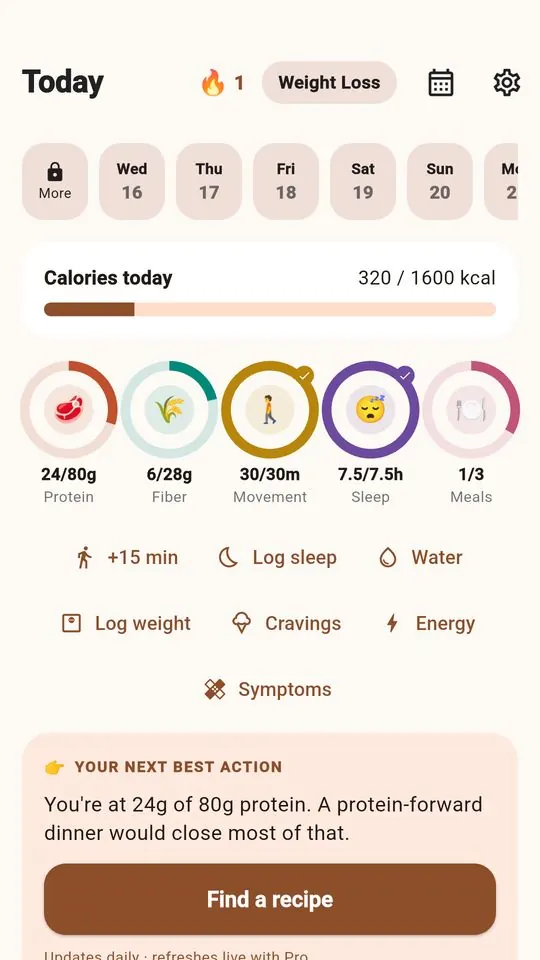
In the PCOS Weight Loss app, the meal score is built from four parts: protein, fiber, added sugar and quality, which is how processed the food is. Protein and fiber each make up 30% of the score, added sugar is 20% and quality is 20%. Those weights, and the reference numbers behind them, are published on the how the score works page.
The references themselves are plain and few: 7 g of protein per 100 kcal, 2 g of fiber per 100 kcal, and a flat 12 g line for added sugar, with minimally processed food counting more than ultra-processed food by calories. These are general nutrition references the score uses for comparison, not clinical thresholds and not a pass-or-fail line for any single meal. A gentle nutrition approach uses them the same way: as a starting point for comparing one meal with another, not as a target to hit every time.
The quality part works the same way behind the scenes: minimally processed food counts as 1.0, processed food counts as 0.6, and ultra-processed food counts as 0.15, by calories within the meal. That comparison is explained in more detail in what is ultra-processed food, and the four parts combine unrounded before the final number is rounded for display — so a meal with strong fiber can offset a weaker added-sugar part rather than any single part deciding the outcome alone.
How is gentle nutrition different from counting calories in the app?
The app offers two ways to track, and the gentle version is simply the one with fewer numbers on screen. Gentle Mode has no calories and no scale anywhere in it — just the meal score and the five progress rings for protein, fiber, movement, sleep and meals. Weight Loss Mode keeps the same meal score but adds calories, macros and a weight trend alongside it, for anyone who wants that extra layer.
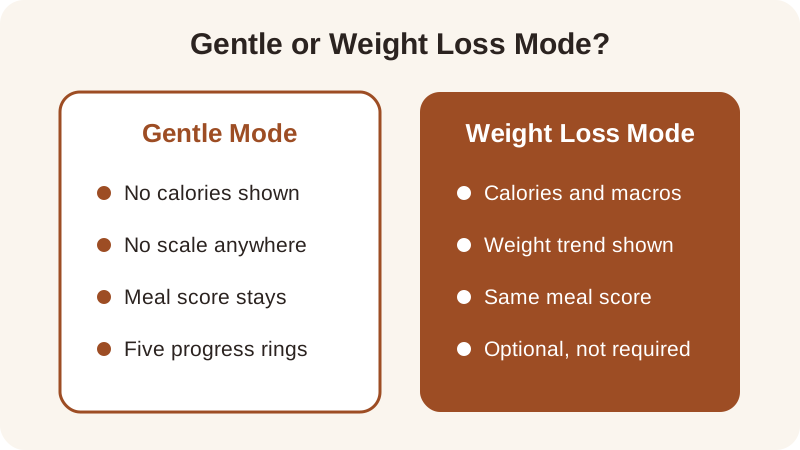
Switching between the two does not change how a meal is scored. A bowl of lentil soup gets the same protein, fiber, added-sugar and quality numbers whether or not the screen also shows its calories. The choice is just how many numbers you want to look at alongside it.
Cycle days, without the extra layer
The same gentle idea carries over to cycle tracking: cycle days can be logged with no predicted period, no fertile window and no phase names attached to them. It is a record, not a forecast.
What does a gentle swap look like at a real meal?
Worked examples are easier to use than rules. The table below takes four of the site's recipes and works out protein and fiber per 100 kcal for each — the same arithmetic the meal score runs in the background.
| Recipe | Protein per 100 kcal (about) | Fiber per 100 kcal (about) | Meal score |
|---|---|---|---|
| Edamame with Sea Salt | 8.9 g | 4.2 g | 10.0 |
| Turkey Chili | 7.5 g | 2.7 g | 9.3 |
| Lentil & Spinach Soup | 5.9 g | 4.1 g | 9.2 |
| Apple with Almond Butter | 2.7 g | 2.7 g | 6.8 |
None of these foods is better or worse to eat — the table only shows which ones push the protein and fiber parts of the score higher per 100 kcal. An apple with almond butter still scores 6.8 out of 10; stirring a spoon of cottage cheese alongside it, or trading the almond butter for edamame on the side, raises the protein per 100 kcal without changing the rest of the plate.
How do you start a gentle nutrition approach without a scale?
Logging a meal by hand is free, has no daily limit, and sends nothing off the phone — it stays local, the same as weight, cycle days and symptoms logged anywhere in the app. A meal photo works too: the free version scores three meal photos in any 24 hours, and the photo is sent to the app's server and on to a food-recognition service to identify what's on the plate, with no copy kept afterward. Either way, the portion shown on the score screen is editable, and the app does not remember a portion for the next photo.
The five rings — protein, fiber, movement, sleep and meals — are progress rings, not parts of the meal score itself. They sit alongside the score as a loose daily picture rather than another number to hit exactly.
Snacks follow the same gentle logic as full meals. Cottage cheese with cucumber, or edamame with a little sea salt, each works out its own protein and fiber per 100 kcal, and both show up with their full scores in the high fiber snacks with protein guide if you want more ideas to try between meals.
For a longer look at this side of the app, the PCOS app without calorie counting guide covers Gentle Mode in more depth, and the Gentle Mode page walks through what is and is not shown on screen. Between hand logging, photo scoring and the recipes, a gentle nutrition approach to PCOS ends up being mostly arithmetic done quietly in the background, with one food idea offered back at the end of each meal.
Frequently asked questions
What makes a nutrition approach to PCOS 'gentle'?
It describes what is in a meal — protein, fiber, added sugar, how processed it is — instead of counting calories or tracking weight. The meal score turns those four parts into one number out of 10, and Gentle Mode keeps calories and the scale out of the picture entirely.
Do I need Weight Loss Mode to use this approach?
No. Gentle Mode has no calories and no scale anywhere in the app, and scores meals the same way as Weight Loss Mode, which adds calories, macros and a weight trend next to the score for anyone who wants that view.
Does gentle nutrition mean added sugar is off-limits?
No food is off-limits here. The added-sugar part of the score compares a meal against a flat 12 g reference, and a meal with less added sugar scores higher on that one part — it is a reference the score uses, not a rule about what to eat.
Can a gentle nutrition approach support weight tracking too?
Yes, if you choose it. Weight Loss Mode shows a weight trend next to the meal score for anyone who wants to track it, while Gentle Mode leaves weight out completely — both use the same protein, fiber, added-sugar and processing score underneath.
What happens if a meal scores low?
The app shows the four parts behind the number and one food idea to try next time, such as a side that adds fiber. It describes the meal's numbers rather than labeling the meal or the person who ate it.
General nutrition information, not medical advice. Figures are estimates. Talk to a doctor or dietitian about your own needs.