 PCOS Weight Loss
Best Protein Sources for PCOS, Scored by the App
A ranking of common animal and plant protein sources by grams per 100 calories, with worked meal examples and recipe scores.
Published
Quick answer
The best protein sources for PCOS are foods with the most protein per 100 calories, like cottage cheese, eggs, turkey, tofu, lentils and edamame. Pairing them with fiber lifts the overall meal score more than protein alone.
Key takeaways
- Cottage cheese, chicken and turkey pack the most protein per 100 calories among animal foods
- Edamame, lentils and tofu add fiber alongside protein, lifting the fiber part of the score too
- The score's protein reference is 7 g per 100 kcal — a general reference, not a target for every meal
- Protein alone doesn't raise fiber, added sugar or quality — all four parts count toward the score
- Gentle Mode scores protein and fiber without showing any calories or a scale
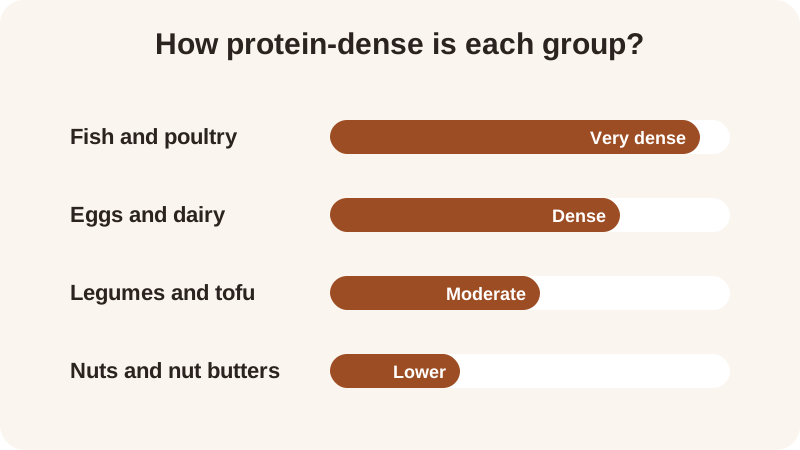
The best protein sources for PCOS are the ones that pack the most protein into their calories, not necessarily the richest-sounding foods — think cottage cheese, eggs, turkey, chicken, tofu, lentils and edamame, each landing at a different number of grams per 100 kcal. This guide ranks a dozen everyday options by that density and scores a few real meals so you can see what one swap changes.
What makes one protein source "better" than another for PCOS?
It comes down to density, not just the total grams on the plate. The meal score's protein part compares a meal's protein against 7 g per 100 kcal — a general nutrition reference, not a clinical target, explained in full on the how the score works page. A food with more protein per calorie lifts that part of the score more than the same food eaten in a bigger portion.
That's why a small serving of cottage cheese can out-score a larger plate of pasta on the protein part alone — it isn't about eating more, it's about what's packed into the calories you already have. The protein per 100 calories guide walks through the arithmetic in more detail, and the same density idea applies whether you're comparing two animal foods, two plant foods, or one of each.
Which animal proteins score highest per 100 calories?
Lean cuts and dairy tend to lead this list. Using the site's scored recipes as worked examples: Cottage Cheese & Cucumber Snack has about 20 g of protein across 180 kcal, which works out to roughly 11.1 g per 100 kcal. Grilled Chicken & Quinoa Salad comes in at 42 g over 460 kcal, about 9.1 g per 100 kcal.
| Recipe | Protein per 100 kcal (about) |
|---|---|
| Cottage Cheese & Cucumber Snack | 11.1 g |
| Grilled Chicken & Quinoa Salad | 9.1 g |
| Veggie & Egg Scramble | 7.6 g |
| Turkey Chili | 7.5 g |
| Baked Salmon with Quinoa & Broccoli | 7.1 g |
All five land at or above the 7 g per 100 kcal reference, which is part of why they each score well above the middle of the 0–10 scale. None of this makes one of them a better choice than another — it only shows which one moves the protein part of a given meal's score the most, and the gap between 11.1 g and 7.1 g is still small compared with how far below the reference a lower-density meal might sit.
Which plant protein sources work well in a PCOS meal?
Plant protein sources often bring an added bonus: more fiber per 100 kcal alongside the protein, which can lift two parts of the score at once since protein and fiber are each worth 30% of the total. Edamame with Sea Salt has about 17 g of protein and 8 g of fiber across 190 kcal — roughly 9.0 g of protein and 4.2 g of fiber per 100 kcal.
| Recipe | Protein per 100 kcal | Fiber per 100 kcal |
|---|---|---|
| Edamame with Sea Salt | 9.0 g | 4.2 g |
| Lentil & Spinach Soup | 5.9 g | 4.1 g |
| Tofu & Vegetable Stir-Fry | 5.7 g | 2.1 g |
| Chickpea & Feta Salad | 4.3 g | 2.9 g |
None of these are as protein-dense as chicken or cottage cheese on their own, but their fiber per 100 kcal clears the 2 g reference used by the fiber part of the score — so a lentil or chickpea meal can land a similar final score through a different mix of parts. Lean protein options and plant protein sources end up in roughly the same score range for different reasons, which is one more argument for looking at the whole score rather than protein grams alone.
Does picking a high-protein food guarantee a higher meal score?
No — protein is only 30% of the meal score. Fiber is another 30%, added sugar is 20% and quality (how processed the food is) is the remaining 20%, and the four parts are combined unrounded before the final number is rounded for display. A food that's protein-dense but low in fiber, high in added sugar, or heavily processed can still land in the middle of the scale rather than the top.
Apple with Almond Butter is a useful contrast: it has only about 6 g of protein across 220 kcal (2.7 g per 100 kcal, below the reference), yet its fiber and quality hold the score up to 6.8. Compare that with the Edamame with Sea Salt recipe, which scores a full 10.0 because protein, fiber and quality all land strongly at once. In the quality part specifically, minimally processed food counts 1.0 by calories, processed food counts 0.6 and ultra-processed food counts 0.15 — so a protein-dense food that's also minimally processed has an advantage a protein-dense but ultra-processed food doesn't. Try your own combinations in the meal score calculator to see which part moves.
How do you track protein sources across a full day, not just one meal?
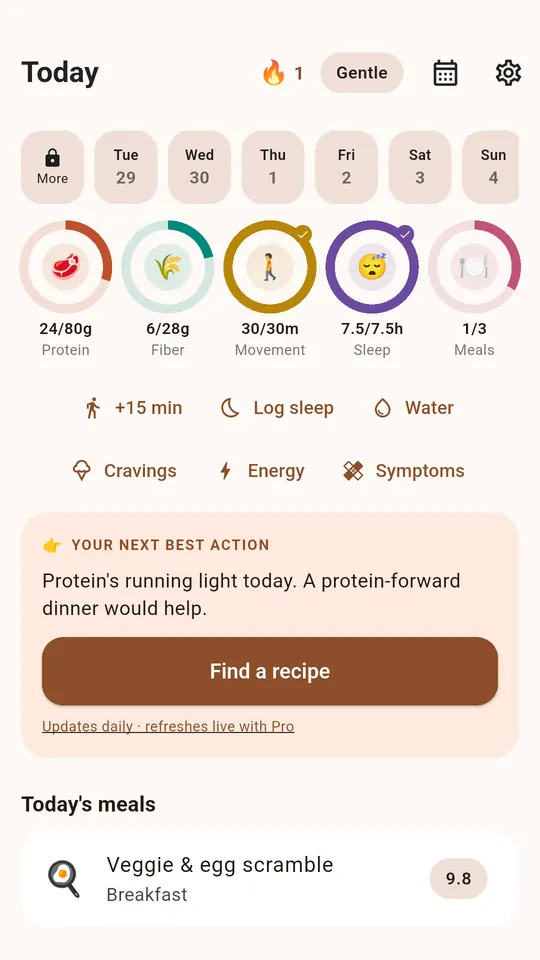
A single high-protein meal doesn't carry a whole day's worth of protein, so it helps to see the pattern rather than one snapshot. The app's five rings — protein, fiber, movement, sleep and meals — are progress rings, separate from the 0–10 meal score, and they give a day-level view of how protein shows up meal to meal rather than judging any single plate in isolation.
Logging works either way: a meal photo is sent off the phone to identify the food and nutrition figures from a photo are estimates, while logging by hand is free, has no daily limit, and sends nothing off the phone. The PCOS tracker keeps meals, cycle days and symptoms together, and the fiber tracker shows the fiber side of the same meals if that's the part you want to watch most closely alongside protein. Whichever way you log, the portion is editable on the score screen, and the app doesn't carry that portion over to the next photo, so each meal gets its own check.
If counting calories isn't something you want to do, Gentle Mode still scores the protein and fiber in a meal — it just does it with no calories and no scale anywhere in the app, so you can still see which animal protein, plant protein or mixed meal lands higher without tracking a number you don't want to see. Weight Loss Mode, by contrast, shows the same score next to calories, macros and a weight trend, for anyone who wants that extra layer of detail.
Frequently asked questions
What is the best protein source for PCOS breakfast?
Eggs, Greek yogurt and cottage cheese are common picks because they pack protein into a smaller calorie count — a Veggie & Egg Scramble has about 26 g of protein across 340 kcal, roughly 7.6 g per 100 kcal. Pairing any of them with a fiber source rounds out the score further.
Is plant protein as good as animal protein for PCOS meal scoring?
The score treats a gram of protein the same regardless of source, so lentils, tofu and edamame count exactly like chicken or eggs toward the protein part. Plant options often add more fiber per 100 kcal too, which lifts their fiber score at the same time.
How much protein should a meal have?
The app's protein reference is 7 g per 100 kcal, a general nutrition reference rather than a target for every meal. A meal above that density scores higher on the protein part; one below it still scores on a sliding scale, not pass-or-fail.
Do protein bars count as a good protein source for PCOS?
Some do, but many carry added sugar that lowers the added-sugar part of the score even when protein looks high. Checking grams of added sugar per 100 kcal, as covered on the protein bars page, shows whether a bar's protein outweighs its sugar.
Can Gentle Mode track protein without counting calories?
Yes — Gentle Mode scores the protein and fiber parts of a meal with no calories and no scale anywhere in the app, while Weight Loss Mode adds calories, macros and a weight trend alongside the same score.
General nutrition information, not medical advice. Figures are estimates. Talk to a doctor or dietitian about your own needs.